
Siraa Health
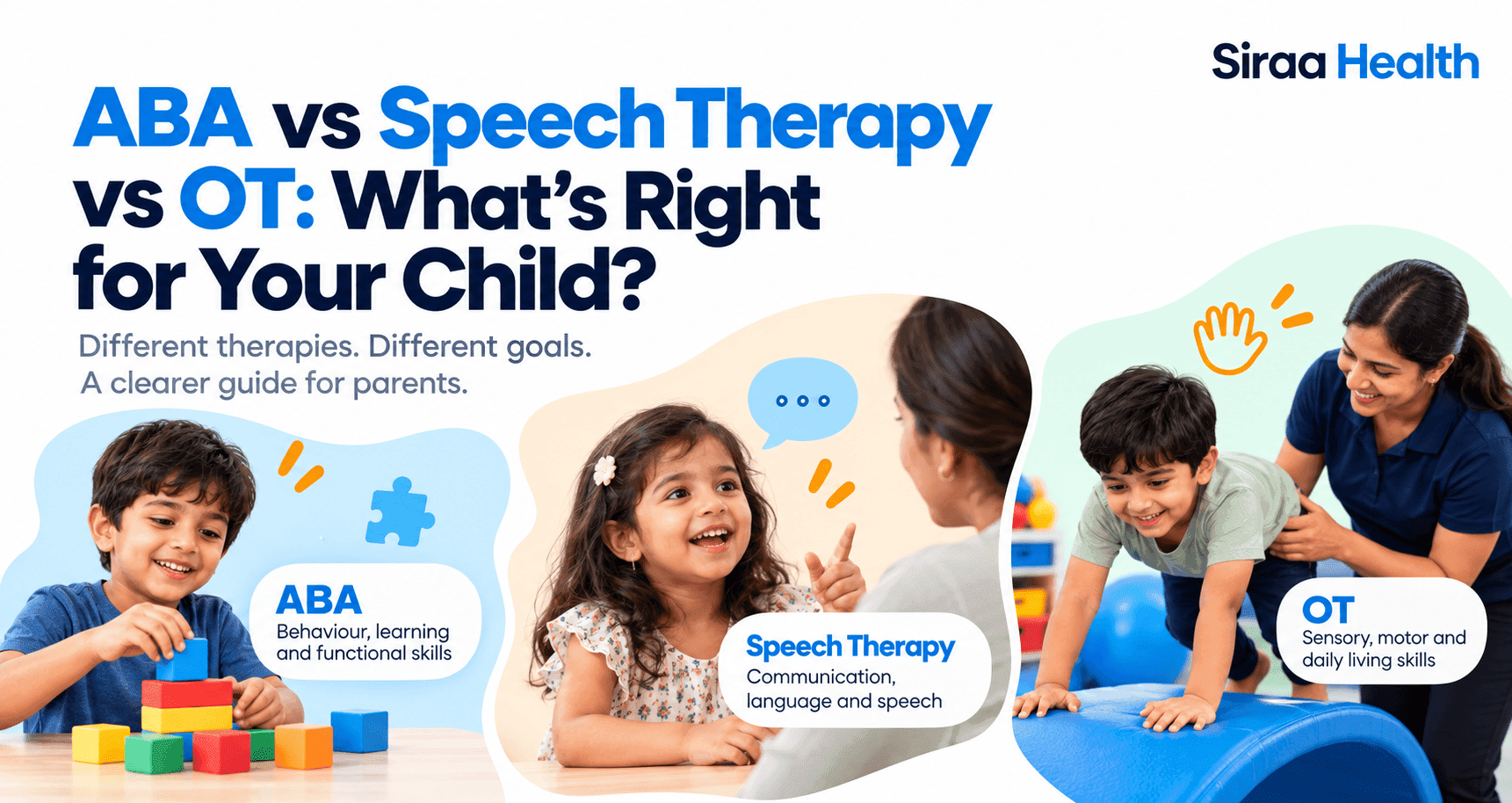
ABA vs Speech Therapy vs OT: What's Right for Your Child?
"My child has a speech delay. Should we start speech therapy or ABA?"
"The therapist suggested OT, but my child doesn't have a physical problem. Why would they need it?"
"My child has autism. Do they need ABA, speech therapy and occupational therapy together?"
These are very common questions for parents.
When you first start looking into developmental therapies, it can feel confusing. You may come across ABA, speech therapy, occupational therapy, developmental therapy, behavioural therapy and several other approaches.
The most important thing to understand is that these therapies are not interchangeable.
Each one focuses on different skills.
ABA may focus on learning, behaviour and functional skills. Speech therapy focuses on communication and language. Occupational therapy can support motor skills, sensory processing and everyday activities.
Some children may benefit from one of these therapies. Others may benefit from a combination.
The right choice depends on your child's individual strengths, challenges, developmental profile and goals.
This is something we see a lot at Siraa Health. Parents often come looking for "the best therapy," when the better question is: "What does my child actually need help with?"
Quick Answer
What is the difference between ABA, speech therapy and OT?
Therapy
Main Focus
Examples of Skills
ABA
Behaviour, learning and functional skills
Following instructions, learning routines, communication, reducing behaviours that interfere with learning
Speech Therapy
Speech, language and communication
Talking, understanding language, expressing needs, social communication
Occupational Therapy (OT)
Motor, sensory and daily living skills
Fine motor skills, dressing, feeding, play, handwriting, sensory regulation
Combination
Multiple developmental needs
Communication + behaviour + sensory/motor or daily living skills
These therapies can sometimes overlap, but they are designed to address different areas of development. The CDC describes behavioural approaches such as ABA, speech and language therapy, and occupational therapy as different intervention categories that may be used according to an individual's needs.
Key Takeaways
ABA, speech therapy and OT have different goals.
Speech therapy isn't only about pronunciation; it can address language and communication.
OT isn't only for physical problems; it can support fine motor, sensory and daily living skills.
ABA can work on learning, behaviour and functional skills.
A child doesn't need autism to benefit from speech or occupational therapy.
Some children benefit from more than one therapy.
Therapy should be based on your child's needs rather than simply their diagnosis.
An assessment can help identify which skills need support and whether therapy is appropriate.
Early support can be helpful when developmental concerns are identified.
What Is ABA Therapy?
ABA stands for Applied Behavior Analysis.
In simple terms, ABA uses principles of learning and behaviour to help children develop useful skills and reduce behaviours that interfere with learning or everyday life.
The CDC describes ABA as a behavioural approach that can encourage desired behaviours and support development of different skills, with progress measured over time.
ABA can be used with children who have autism, but the specific goals and methods should be individualised to the child.
What Can ABA Work On?
Depending on the child's needs, goals may include:
Following instructions
Learning new skills
Building independence
Communication-related behaviours
Social interaction
Daily routines
Learning readiness
Reducing behaviours that interfere with learning
Developing functional skills
For example, a therapist might help a child learn how to communicate that they want a toy rather than becoming frustrated when they cannot access it.
The goal should be meaningful progress in the child's everyday life, not simply making a child appear "more typical."
Does Every Child With Autism Need ABA?
No.
Autistic children have very different strengths and support needs.
Some may benefit from behavioural intervention, while others may primarily need speech therapy, occupational therapy, educational support, psychological support, or a combination.
A developmental evaluation can help identify which areas need support rather than assuming every child needs the same therapy.
What Is Speech Therapy?
Speech therapy is provided by a speech-language pathologist (SLP) or appropriately trained speech and language professional.
And despite the name, speech therapy is about much more than pronunciation.
Speech-language professionals can assess and support speech, language and communication difficulties, including expressive language, understanding language and social communication.
What Can Speech Therapy Help With?
Depending on the child, speech therapy may support:
Delayed speech
Limited vocabulary
Difficulty expressing needs
Difficulty understanding language
Pronunciation difficulties
Speech clarity
Social communication
Conversation skills
Alternative or augmentative communication when appropriate
For example, a 2-year-old who uses very few words may benefit from support to build communication.
An older child may instead need help with speech clarity or social communication.
Does Speech Therapy Only Help Children Who Cannot Talk?
No.
A child can speak clearly and still have communication difficulties.
For example, some children may have difficulty:
Starting conversations
Taking turns while talking
Understanding social cues
Staying on topic
Understanding what someone means
Communicating appropriately in different situations
Speech-language professionals can address these broader communication skills as well.
This is something we see a lot at Siraa Health: parents sometimes assume that "speaking" means communication is fine, but communication involves much more than simply producing words.
What Is Occupational Therapy?
Occupational therapy, or OT, helps children develop skills needed for everyday activities and participation.
For children, this can include playing, dressing, eating, using classroom tools, participating in routines and managing certain sensory challenges.
The American Academy of Pediatrics notes that OT can support areas such as fine motor skills, sensory processing, motor planning, self-care and play.
What Can OT Help With?
Depending on the child's needs, OT may support:
Fine motor skills
Hand strength
Pencil and crayon skills
Dressing
Feeding skills
Using utensils
Brushing teeth
Toileting routines
Play skills
Motor planning
Sensory processing
Participation in school and everyday activities
For example, if a child struggles to hold a spoon, put on their clothes, tolerate certain sensory experiences or participate in age-appropriate play, an OT assessment may be helpful.
ABA vs Speech Therapy vs OT: What's the Difference?
Here's the simplest way to think about it:
ABA asks:
"How can we help this child learn skills and manage behaviours that interfere with everyday functioning?"
Speech Therapy asks:
"How can we help this child communicate and understand others more effectively?"
OT asks:
"How can we help this child participate more independently in everyday activities?"
There can be overlap.
For example, communication may be addressed during ABA, speech therapy and other developmental interventions, but the professional's goals, training and methods may differ.
That's why collaboration between professionals can be useful when a child has multiple needs.
When Does a Child Need More Than One Therapy?
Some children have challenges in several developmental areas.
For example, imagine a 4-year-old child who:
Uses very few words
Has difficulty following instructions
Becomes distressed during transitions
Struggles with dressing
Avoids certain textures
Has difficulty playing with other children
One therapy may not address every area.
The child might benefit from:
Speech therapy for communication.
OT for sensory, motor and daily living skills.
Behavioural or developmental intervention for learning and functional skills.
The exact combination should be decided based on assessment rather than automatically prescribing every available therapy.
The CDC notes that developmental and behavioural approaches may be combined depending on the child's needs.
This is something we see a lot at Siraa Health: the question isn't always "Which therapy?" Sometimes the better question is "Which combination of support will make the biggest difference in this child's everyday life?"
Can a Child Have Speech Therapy Without Having Autism?
Absolutely.
Speech and language difficulties can occur for many different reasons, and a child does not need an autism diagnosis to receive speech-language support.
A child might need speech therapy because of:
Speech delay
Language delay
Speech sound difficulties
Developmental language disorder
Communication difficulties
Fluency difficulties
Social communication difficulties
Speech-language professionals assess communication skills and determine what type of support is appropriate.
Can a Child Have OT Without Having Autism?
Yes.
OT can support children with a wide range of developmental, motor, sensory and functional difficulties.
For example, a child may need OT support for:
Fine motor difficulties
Handwriting challenges
Feeding difficulties
Dressing difficulties
Coordination problems
Sensory processing differences
Difficulty participating in everyday activities
Autism is only one situation in which OT may be useful.
Does Having Autism Mean My Child Needs All Three?
Not necessarily.
Autism is a spectrum, and children can have very different strengths and support needs.
One child may primarily need communication support.
Another may have significant sensory and daily living difficulties.
Another may benefit from behavioural intervention and communication support.
Another may need several forms of support.
The CDC recommends considering the child's individual symptoms, developmental needs and functioning when selecting interventions.
The goal should always be to identify what your child needs help with, rather than selecting therapies simply because they are associated with a particular diagnosis.
How Do You Know Which Therapy Your Child Needs?
Start with an assessment.
A developmental assessment can look at different areas of your child's functioning, including:
Communication
Speech and language
Social interaction
Behaviour
Attention
Play
Fine motor skills
Gross motor skills
Sensory responses
Daily living skills
Depending on the concerns, a child may then be referred to the appropriate professionals.
Formal developmental evaluations can involve several professionals, including developmental paediatricians, child psychologists, speech-language pathologists and occupational therapists.
What If I'm Not Sure Whether My Child Needs Therapy?
You don't have to diagnose your child yourself.
If you notice that your child:
Isn't meeting expected developmental milestones
Has stopped using skills they previously had
Isn't communicating effectively
Has difficulty following everyday routines
Struggles significantly with behaviour
Has unusual sensory responses
Has difficulty with play or social interaction
Is struggling with daily activities
an assessment can help you understand what's happening.
And an assessment doesn't automatically mean your child needs therapy.
Sometimes parents receive guidance for activities they can practise at home.
Sometimes monitoring is appropriate.
Sometimes therapy is recommended.
Sometimes a child needs evaluation by another professional first.
What Does a Developmental Assessment Look At?
A good assessment should look at your child as a whole rather than focusing on one behaviour.
It may involve:
Parent Discussion
You may be asked about your child's development, communication, behaviour, routines and everyday challenges.
Observation
The professional may observe how your child plays, communicates, responds to instructions and interacts with people.
Skill Assessment
Different developmental areas may be assessed depending on your concerns.
Recommendations
You may receive guidance about whether your child needs speech therapy, OT, behavioural support, further developmental evaluation, or simply monitoring.
The purpose is to understand your child's strengths and areas where additional support may help.
What About Children Who Need Multiple Therapies?
When several professionals are involved, coordination matters.
Imagine your child's speech therapist is working on requesting.
The OT is working on sensory regulation.
The behavioural therapist is working on following instructions.
If everyone is working separately without communicating, parents can end up coordinating multiple appointments, goals and recommendations themselves.
A coordinated approach can help professionals understand what the others are working on and keep goals connected to everyday life.
This is particularly useful when several developmental areas overlap.
A Simple Comparison for Parents
| Question | ABA | Speech Therapy | Occupational Therapy | |---|---|---| | Communication | May support functional communication and learning behaviours | Core area of therapy | May support participation in communication-related activities | | Behaviour | Core area for many ABA programmes | May address communication-related frustration | May address sensory or functional factors affecting participation | | Speech | Not the primary specialty | Core area | Not the primary specialty | | Language | May support learning communication skills | Core area | Not the primary specialty | | Sensory Processing | May consider behaviour related to sensory experiences | Not the primary specialty | Common area of focus | | Fine Motor Skills | Not the primary focus | Not the primary focus | Core area | | Daily Living Skills | Can support functional independence | May support communication within routines | Core area | | Play Skills | May use play for learning | May use play to develop communication | May use play to develop motor and functional skills |
The table is a simplified guide. Actual therapy goals vary depending on the child's assessment and the professional's scope of practice.
When Should You Seek Professional Help?
Consider discussing your concerns with your child's paediatrician or a developmental professional if you notice:
Delayed speech or language
Limited communication
Difficulty understanding instructions
Frequent or intense behavioural challenges
Difficulty with social interaction
Sensory sensitivities affecting daily life
Delays in fine or gross motor skills
Difficulty with dressing, feeding or other daily activities
Loss of previously acquired skills
Concerns across more than one developmental area
You don't have to wait until your child's difficulties become severe.
The CDC recommends acting early when parents have concerns about development, and notes that early intervention can support children with developmental delays and disabilities.
The Goal Isn't More Therapy. It's the Right Therapy.
It can be tempting to think that if one therapy is good, three therapies must be better.
But that's not necessarily true.
Your child doesn't need the maximum number of therapy sessions.
Your child needs the right goals, the right professionals and the right level of support for their individual needs.
Therapy should also fit into your child's life.
A good plan should consider what matters to your family, what your child enjoys, and which skills will make everyday activities easier.
Frequently Asked Questions
Q: Which is better for autism: ABA, speech therapy or OT?
A: There isn't one therapy that is automatically best for every child. ABA, speech therapy and OT target different areas, and some children benefit from one while others benefit from a combination. The right choice depends on your child's individual developmental profile and goals.
Q: Does my child need ABA if they have autism?
A: Not necessarily. Some autistic children may benefit from behavioural intervention, while others may need speech therapy, OT, developmental support or other services. A professional assessment can help identify which areas need support.
Q: Can speech therapy and ABA be done together?
A: Yes. Some children receive both because the therapies may address different goals. Good coordination between professionals can help ensure that communication and learning goals complement each other.
Q: Does occupational therapy help with speech delay?
A: OT is not primarily a speech therapy, but it may support sensory, motor or daily living challenges that affect a child's participation and learning. If speech or language is the main concern, a speech-language assessment is usually appropriate.
Q: Does my child need therapy if they are not autistic?
A: No autism diagnosis is required for many developmental therapies. Children with speech, language, motor, sensory, behavioural or developmental difficulties may benefit from therapy depending on their individual needs.
Q: How do I know if my child needs multiple therapies?
A: Look at the different areas where your child is struggling. If concerns involve communication, behaviour, sensory processing, motor skills and daily living at the same time, a broader developmental assessment can help determine whether multiple professionals may be useful.
Q: Can therapy start before an autism diagnosis?
A: In many situations, support for specific developmental concerns does not need to wait for a formal autism diagnosis. For example, a child with a clear communication delay may be referred for speech and language support while the broader developmental evaluation continues.
Q: What should I do if I don't know which therapy my child needs?
A: Start with an assessment rather than choosing a therapy based only on a diagnosis or something you read online. An assessment can help identify your child's strengths, challenges and the type of support that may be appropriate.
Final Thoughts
ABA, speech therapy and occupational therapy each have an important but different role in supporting children.
The right question isn't "Which therapy is the best?"
It's "What does my child need help with right now?"
If your child's biggest challenge is communication, speech therapy may be an important part of their care.
If they are struggling with sensory processing, fine motor skills or everyday activities, OT may be helpful.
If learning, behaviour or functional skills are the main concern, a behavioural approach may be considered.
And if your child has needs across several areas, a coordinated combination may make sense.
At Siraa Health, we believe parents shouldn't have to figure this out by themselves. Understanding your child's development first can help you make a clearer decision about what support comes next.
Every child is different. The goal isn't to fit your child into a therapy plan. The goal is to build the right support around your child.
Get expert advice from Siraa Health doctors