
Siraa Health
You're standing in a supermarket checkout line.
Your three-year-old spots a chocolate bar and asks for it. You say no.
Suddenly they're crying, shouting, and lying on the floor.
A few days later, your child covers their ears during a family gathering, starts screaming, and cannot calm down despite your best efforts.
Both situations may look similar from the outside.
But they could be completely different experiences for your child.
Most parents worry about this.
The good news is that understanding the difference between a tantrum and a meltdown can help you respond more effectively and support your child's emotional and developmental growth.
This is something we see a lot at Siraa Health. Many parents feel relieved when they learn that not all big emotional reactions mean the same thing.
When we misunderstand a child's behaviour, we often respond in ways that don't help.
A child having a tantrum may need clear boundaries and consistency.
A child experiencing a meltdown may need support, comfort, and help regulating their emotions.
Responding correctly can reduce stress for both you and your child.
Behavioural therapy often begins by helping parents understand what is driving a behaviour before deciding how to respond.
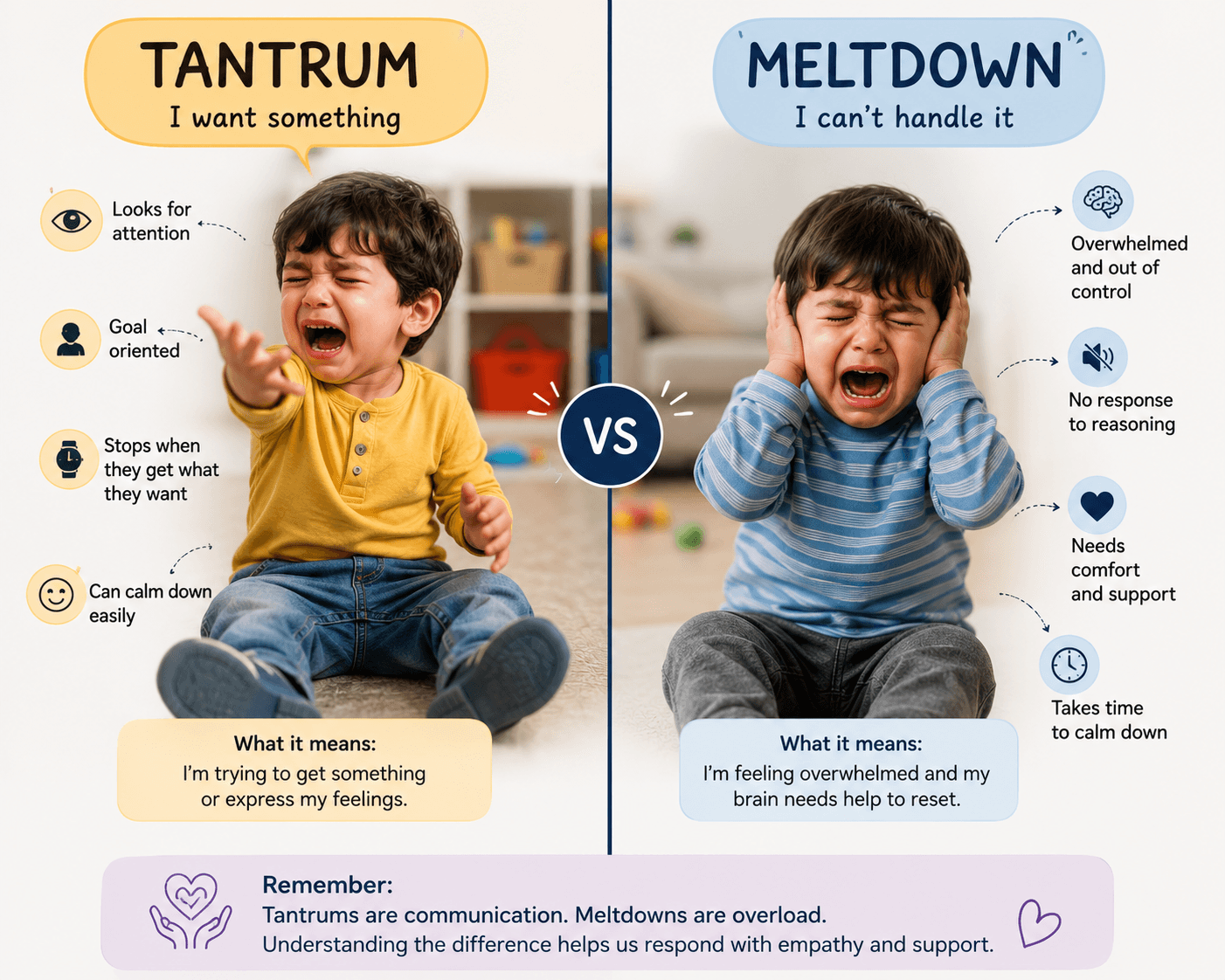
A tantrum is a child's way of expressing frustration when they do not get what they want or when something does not go their way.
Tantrums are a normal part of development, especially in toddlers and preschool-aged children.
Young children are still learning how to manage emotions, communicate needs, and cope with disappointment.
This is something we see a lot at Siraa Health during the early years of child development.
Children may have tantrums because:
Tantrums usually have a goal or desired outcome.
For example:
A child having a tantrum often remains aware of what is happening around them.
They may stop briefly to see if their behaviour is working.
They may also calm down if they get what they want.
A meltdown is very different.
A meltdown happens when a child becomes completely overwhelmed and loses the ability to cope with what they are experiencing.
This can happen because of:
Many neurodivergent children experience meltdowns, including children with autism, ADHD, sensory processing differences, and developmental challenges.
This is something we see a lot at Siraa Health among children receiving behavioural therapy and developmental support.
A meltdown may be triggered by:
Unlike tantrums, meltdowns are not usually driven by a desire to achieve a specific outcome.
Children experiencing a meltdown may:
During a meltdown, your child is often not in a position to reason, negotiate, or follow instructions.
They are overwhelmed and need support.
| Feature | Tantrum | Meltdown |
|---|---|---|
| Usually has a goal | Yes | No |
| Primary trigger | Frustration, not getting something wanted | Overwhelm, sensory stress, anxiety, or emotional overload |
| Child aware of surroundings | Usually yes | Often limited |
| Can stop if desired outcome is achieved | Often yes | Usually no |
| Responds to rewards or consequences | Sometimes | Rarely |
| Child has control over behaviour | Some degree of control | Little or no control |
| Needs discipline or limit-setting | Sometimes | No |
| Needs emotional support and regulation | Helpful | Essential |
| Ability to reason during episode | Often possible | Usually not possible |
| Best response from adults | Stay calm, maintain boundaries, acknowledge feelings | Reduce demands, provide comfort, create a calm environment |
| Typical causes | Wanting something, attention-seeking, frustration, tiredness, hunger | Sensory overload, changes in routine, communication difficulties, fatigue, anxiety |
| Common behaviours | Crying, shouting, stomping, arguing, refusing instructions | Intense crying, screaming, covering ears, hiding, running away, shutting down |
| Age group | Most common in toddlers and preschoolers | Can occur at any age |
| Purpose of behaviour | To express dissatisfaction or achieve an outcome | A response to being overwhelmed and unable to cope |
Understanding this difference can completely change how you support your child.
Children who process the world differently often experience more situations that feel overwhelming.
A busy birthday party may feel exciting to one child and exhausting to another.
A simple change in routine may feel manageable to one child but deeply stressful to another.
When these challenges build up, a meltdown can occur.
This is something we see a lot at Siraa Health in children receiving support for paediatric development concerns.
Some children are highly sensitive to:
What seems minor to adults may feel overwhelming to them.
If a child cannot express what they need, frustration can build quickly.
They may struggle to communicate:
Behaviour often becomes their way of communicating.
Many children find transitions challenging.
Examples include:
Predictability often helps reduce stress.
The goal is not to "win."
The goal is to help your child learn healthy ways to handle frustration.
Your child looks to you for cues.
A calm response often helps the situation resolve faster.
If the answer is no, avoid changing it simply to stop the tantrum.
Consistency helps children understand expectations.
You can say:
Validation does not mean giving in.
Once your child calms down, acknowledge their effort.
Positive reinforcement helps build emotional skills.
A meltdown requires a different approach.
Avoid lengthy conversations, questions, or instructions.
Your child may not be able to process them.
If possible:
This is something we frequently recommend at Siraa Health.
Every child is different.
Some prefer:
Follow your child's cues.
Teaching and problem-solving should happen after your child has fully recovered.
Learning rarely happens in the middle of a meltdown.
Many parents assume behavioural therapy only focuses on reducing difficult behaviours.
In reality, behavioural therapy helps children build skills.
These may include:
Behavioural therapy also helps parents identify triggers and respond consistently.
The goal is not to stop emotions.
The goal is to help children manage emotions more effectively.
This is something we see a lot at Siraa Health.
When parents understand behaviour better, family life often becomes less stressful.
Small changes can make a big difference.
Children often feel safer when they know what to expect.
Pictures and routines can help children prepare for upcoming activities.
Tired children often struggle more with emotional regulation.
Notice patterns.
Does behaviour occur:
Understanding triggers helps you plan ahead.
Consider speaking with a healthcare professional if:
Seeking support does not mean something is wrong with your child.
It means you're looking for tools to better understand and support them.
Most parents worry about this, and asking for help is often the first step toward finding answers.
When your child is crying, screaming, refusing, or overwhelmed, it can be hard to know what they need at that moment.
Sometimes they are frustrated and testing limits.
Sometimes they are overwhelmed and struggling to cope.
Understanding whether you're seeing a tantrum or a meltdown allows you to respond with greater confidence and compassion.
The good news is that children can learn emotional skills over time.
With patience, consistency, and the right support, many families find that difficult moments become easier to navigate and understand.
Get expert advice from Siraa Health doctors