
Siraa Health
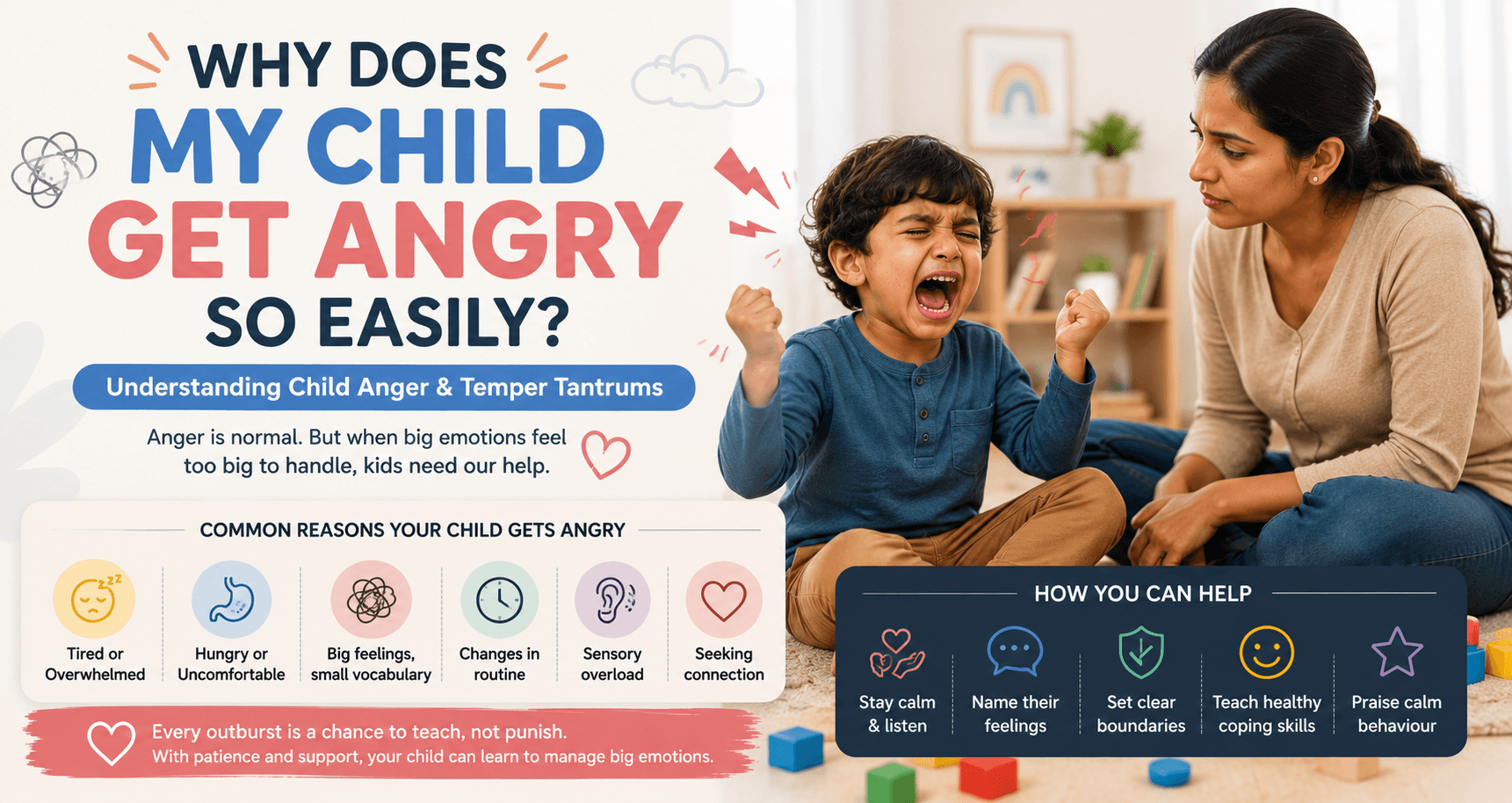
Many children who appear "angry" are actually feeling overwhelmed, anxious, frustrated, or misunderstood. Anger is often a signal that something deeper is going on rather than simply "bad behaviour."
Young children naturally want things to happen immediately. When they can't:
their frustration can build very quickly.
Learning patience and coping with disappointment are important developmental skills that take time to develop.
Children often feel safest when life is predictable.
Major changes such as:
can make them feel uncertain or unsettled.
Sometimes, anger is simply their way of expressing discomfort with change.
Some children become overwhelmed by sensory experiences such as:
When the brain struggles to process all this information, anger may become an outward response.
This is especially common in some neurodivergent children.
Children who struggle with speech or language development often become frustrated because they cannot express what they need.
Imagine knowing exactly what you want but not having the words to explain it.
That frustration can quickly turn into anger.
Sometimes children act out because they need connection—not because they're trying to misbehave.
Children naturally seek attention from the people they love. In some situations, even negative attention can feel better than feeling ignored.
Behaviour is often a child's way of saying:
"I need you."
Parents often use these terms interchangeably, but they're not exactly the same.
| Anger | Temper Tantrum |
|---|---|
| An emotion | A behaviour |
| Can be expressed calmly | Often involves crying, screaming, hitting or throwing things |
| Can happen at any age | Most common in toddlers and preschoolers |
| Usually has an underlying cause | Often occurs when children cannot regulate their emotions |
| Can exist without a tantrum | One possible expression of anger |
A child can feel angry without having a tantrum.
Likewise, not every tantrum is caused by anger. Children may also have tantrums because they are:
Most episodes of anger are a normal part of childhood development.
However, frequent, intense, or persistent anger can sometimes be associated with underlying developmental or behavioural challenges, including:
This does not automatically mean your child has one of these conditions.
It simply means that persistent anger—especially when accompanied by other developmental concerns—deserves a closer assessment.
This is something we see regularly at Siraa Health. Many parents initially seek help because of anger or tantrums, but assessments sometimes uncover underlying developmental challenges that can be effectively addressed with the right support.
Imagine you've had one of the worst days at work.
Now imagine someone shouting at you because you're upset.
Would that help you feel calmer?
Probably not.
Children experience emotions in much the same way.
Punishing anger may stop a behaviour temporarily, but it doesn't teach children how to understand or manage the emotion behind it.
Instead, children benefit from calm adults who can:
Learning to manage emotions is a gradual process, but it's one of the most valuable life skills a child can develop.
When your child is shouting, crying, or throwing things, your first instinct might be to stop the behaviour immediately.
But before reacting, remember this:
Your child is having a hard time—not trying to give you a hard time.
Children borrow their calm from the adults around them.
The calmer you remain, the easier it becomes for your child to regulate their emotions.
This is something we see often at Siraa Health. Parents frequently notice that when they change the way they respond, their child's reactions gradually begin to change too.
When emotions rise, children look to you for safety.
If you respond by shouting, threatening, or arguing, your child's emotional brain becomes even more overwhelmed.
Instead:
Your calm response teaches your child what emotional regulation looks like.
Young children often don't yet have the words to describe what they're feeling.
You can help by putting those feelings into words.
For example:
"You seem really frustrated because your tower fell down."
"I can see you're feeling angry because it's time to leave the park."
"You're disappointed because you wanted more screen time."
Naming emotions helps children build emotional awareness, making it easier for them to express feelings with words instead of behaviour.
Understanding your child's emotions does not mean accepting hurtful behaviour.
You can be compassionate while still setting firm limits.
For example:
"It's okay to feel angry. It's not okay to hit."
"I won't let you throw toys because someone could get hurt."
Children need both empathy and boundaries.
This balance helps them feel safe while learning self-control.
Anger itself isn't the problem.
It's how children express it that matters.
Encourage your child to:
Practice these skills during calm moments—not in the middle of an emotional outburst.
Every child's anger has a pattern.
Keeping a simple diary for a week can help you identify it.
Write down:
Many parents are surprised by how quickly patterns emerge.
Perhaps your child becomes angry:
This is something we often see at Siraa Health. Once families identify triggers, preventing emotional outbursts often becomes much easier.
Children don't learn emotional regulation during meltdowns.
They learn through everyday interactions.
Simple activities that help include:
Children learn far more from what we do than from what we say.
Parenting is hard.
Every parent loses patience sometimes.
The goal isn't perfection—it's progress.
Here are some common mistakes that can unintentionally increase anger.
When adults raise their voices, children often become more overwhelmed rather than calmer.
Young children simply don't have adult levels of emotional control.
Learning to manage anger takes years of practice.
A hungry, tired, or overstimulated child is much more likely to become angry.
Meeting these needs can prevent many emotional outbursts before they begin.
Every child develops differently.
Comparing siblings or classmates often increases pressure without addressing the underlying issue.
Children thrive on positive attention.
Notice and praise moments when your child manages frustration well.
Even small improvements deserve recognition.
Occasional anger and temper tantrums are a normal part of childhood.
However, it may be helpful to speak with a healthcare professional if your child's anger:
Trust your instincts.
Parents are often the first people to notice subtle changes in their child's behaviour.
Seeking guidance doesn't mean you've failed as a parent.
It simply means you're looking for answers and support.
This is something we see regularly at Siraa Health. Many families tell us they wish they had sought guidance sooner because early support often brings both reassurance and practical solutions.
Every child gets angry.
Every child has moments when emotions feel too big to manage.
These moments don't define your child—and they don't define your parenting.
The good news is that emotional regulation is a skill.
Like learning to walk, read, or ride a bicycle, it develops over time through patience, practice, and support.
Your child doesn't need a perfect parent.
They need a parent who stays curious, offers guidance, and helps them feel safe enough to learn.
Sometimes the biggest lesson we can teach our children isn't how to stop feeling angry.
It's how to move through anger in healthy ways.
Every calm conversation, every comforting hug, and every opportunity to teach a new coping skill helps your child build emotional resilience that will last a lifetime.
Young children often experience frustration as they learn to manage emotions.
However, if anger is intense, happens very frequently, or affects daily life, it's worth discussing with a healthcare professional.
What seems small to an adult can feel very important to a child.
Hunger, tiredness, sensory overload, frustration, or difficulty communicating can all make emotional reactions seem much bigger.
Anger is an emotion, while a temper tantrum is one way that emotion may be expressed.
Children can feel angry without having a tantrum, and tantrums can also happen because of tiredness, disappointment, or feeling overwhelmed.
It's important to set boundaries around unsafe behaviour, but punishing the emotion itself is rarely helpful.
Instead, focus on teaching healthy ways to express anger while responding calmly and consistently.
Yes.
Children who struggle to communicate their needs may become frustrated more easily because they cannot express what they're thinking or feeling.
Some children with ADHD, autism, or other developmental differences experience challenges with emotional regulation.
Anger alone doesn't mean your child has one of these conditions, but persistent concerns should be discussed with a healthcare professional.
Stay calm, acknowledge your child's feelings, keep everyone safe, and teach calming strategies during peaceful moments.
Over time, children learn these skills through repetition, patience, and consistent support.
Get expert advice from Siraa Health doctors