
Siraa Health
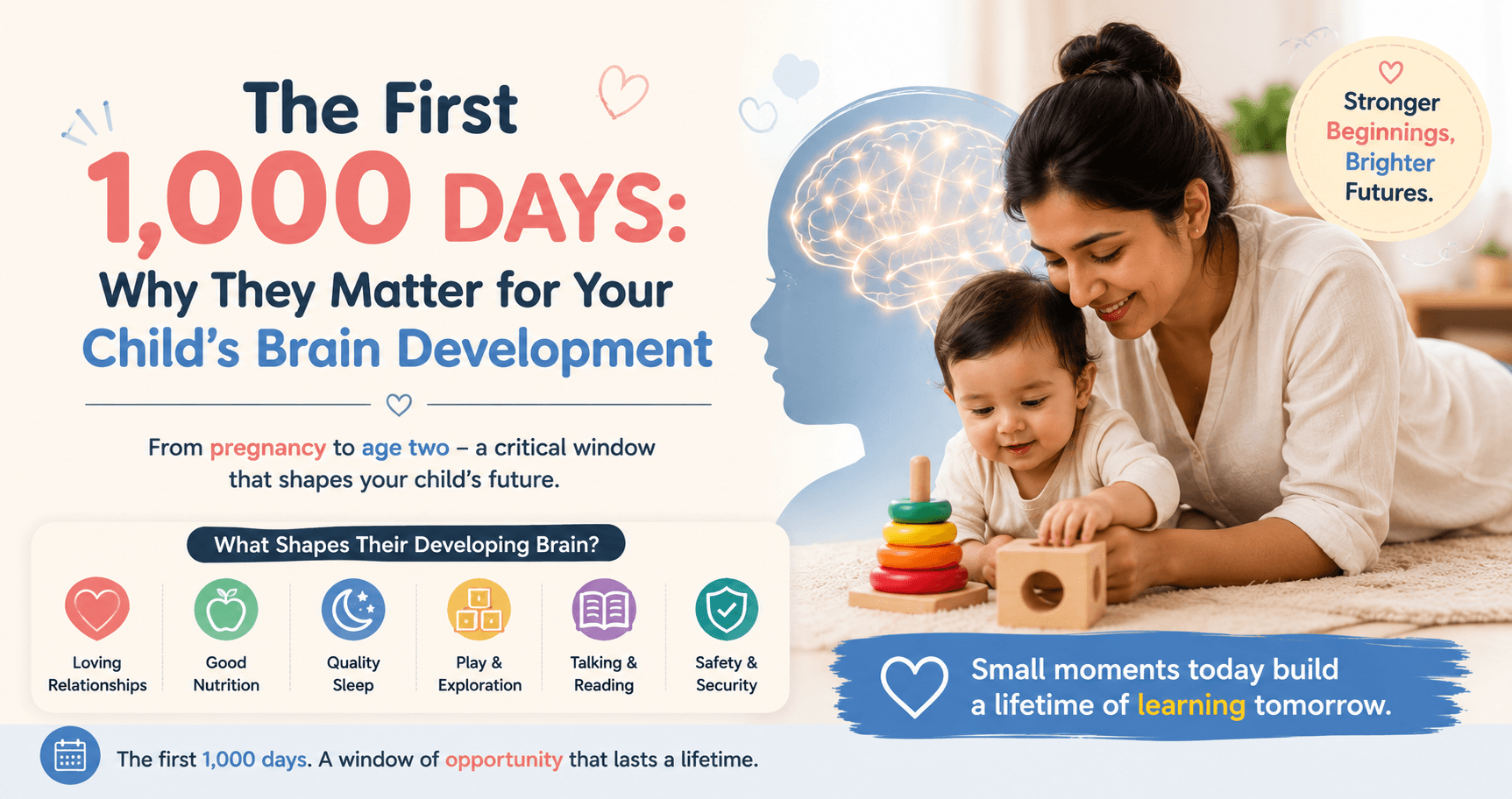
Have you ever looked at your newborn and wondered what is happening inside that tiny brain?
Your baby may spend most of the day sleeping, feeding, or simply looking around. It might seem like very little is happening.
But inside their brain, something incredible is taking place.
Every cuddle, every conversation, every smile, and every lullaby is helping build millions of new brain connections.
Most parents don't realise just how important these early moments are.
The first 1,000 days—from pregnancy until around your child's second birthday—are one of the most important periods of human development.
During this time, your child's brain develops faster than it ever will again.
This is something we often see at Siraa Health. Many parents worry about buying the right toys or educational products, but the greatest influences on brain development are often the simple moments they already share with their child.
The good news is that you don't need to be a perfect parent.
Small, loving interactions every day can have a lifelong impact.
The first 1,000 days begin at conception and continue until your child's second birthday.
This period includes:
Although your baby may seem tiny, their brain is growing at an extraordinary pace.
During these early years, the brain creates millions of new neural connections every second.
These connections become the foundation for:
Think of your child's brain like the foundation of a house.
A strong foundation supports everything built on top of it.
The same is true for brain development.
Experiences during the first 1,000 days help shape learning, health, and wellbeing for years to come.
A baby's brain is designed to learn from everything around them.
Every experience strengthens important brain pathways.
For example:
When you smile at your baby… Their brain learns about relationships.
When you sing… Their brain begins recognising language.
When they reach for a toy… Their brain strengthens movement and coordination.
When they hear your voice… New communication pathways begin forming.
This is something we often see at Siraa Health. Parents frequently underestimate how much learning happens during everyday routines like feeding, cuddling, playing, and talking.
You may have heard the word neuroplasticity.
It sounds complicated, but the idea is actually quite simple.
Neuroplasticity is the brain's ability to learn, adapt, and build new connections throughout life.
During the first 1,000 days, neuroplasticity is at its highest.
This means your baby's brain is especially ready to:
Imagine wet cement.
Before it dries, it can be shaped easily.
As time passes, it becomes harder to change.
A young child's brain works in a similar way.
The earlier positive experiences happen, the easier it becomes for the brain to build strong, healthy pathways.
Many different factors work together to support healthy child development.
Let's explore the most important ones.
One of the strongest influences on brain development isn't technology.
It's relationships.
When your baby feels safe, comforted, and loved, their brain develops stronger emotional connections.
Simple moments matter:
These interactions help your baby learn that the world is safe and predictable.
This is something we often see at Siraa Health. Parents are frequently surprised that everyday affection has such a powerful impact on brain development.
Growing brains need good nutrition.
During pregnancy and early childhood, important nutrients support healthy brain growth.
These include:
Breastfeeding, when possible, also provides valuable nutrition while supporting bonding.
Every family is different.
Whether breastfeeding or formula feeding, ensuring your child receives appropriate nutrition is one of the most important investments you can make in their development.
Parents often think sleep is simply about rest.
In reality, the brain remains incredibly active while children sleep.
During sleep, the brain:
Healthy sleep routines play an important role in child development.
Children don't learn best by sitting at a desk.
They learn through play.
Playing helps children develop:
Whether it's stacking blocks, splashing in water, or pretending to cook dinner, play is helping your child's brain grow.
This is something we often see at Siraa Health. Parents sometimes worry they aren't "teaching" enough, when playful everyday interactions are some of the best learning opportunities.
Long before children begin speaking, they are learning language.
Every conversation helps.
You can support language development by:
Even newborns benefit from hearing your voice.
The more language children hear, the stronger the foundation for future communication, literacy, and learning.
No parent can provide every perfect experience.
And that's okay.
Children are remarkably resilient.
However, long-term challenges such as:
can affect brain development.
The goal isn't perfection.
The goal is providing a safe, loving, responsive environment where children have opportunities to learn, explore, and grow.
The good news is that you don't need expensive educational toys or structured lessons to support your child's brain.
Some of the most powerful learning happens during everyday moments.
This is something we often see at Siraa Health. Parents frequently feel relieved to learn that simple daily interactions can have a lasting impact on their child's development.
Your baby learns language long before they speak their first word.
Describe what you're doing as you go about your day.
For example:
"Let's put on your socks."
"Can you hear the birds outside?"
"We're washing your hands."
These everyday conversations expose your child to new words and help build important language pathways in the brain.
Even if your baby is only a few months old, reading aloud is incredibly valuable.
Books help children:
You don't have to finish every page.
The shared experience matters just as much as the story itself.
Play is how young children explore and understand the world.
Different types of play support different areas of development.
| Type of Play | How It Helps Brain Development |
|---|---|
| Building blocks | Develops problem-solving and fine motor skills |
| Pretend play | Encourages creativity and language development |
| Outdoor play | Builds gross motor skills and confidence |
| Puzzles | Improves memory and logical thinking |
| Music and dancing | Supports rhythm, coordination, and listening skills |
| Sensory play | Encourages exploration and curiosity |
Children learn best when they are actively engaged and having fun.
Babies communicate long before they can speak.
They cry, smile, point, babble, and make facial expressions.
When you respond consistently, your baby begins to understand:
These early interactions build emotional security, which supports healthy brain development.
Curiosity is one of the brain's greatest teachers.
When children safely explore their environment, they learn:
Simple activities like crawling, climbing, stacking blocks, or exploring different textures all contribute to healthy development.
Parents receive a lot of advice—some of it helpful, and some of it not.
Let's look at a few common myths.
| Myth | Fact |
|---|---|
| Expensive toys make children smarter. | Loving interactions and play are far more important. |
| Babies are too young to learn. | Babies begin learning from birth—even before birth. |
| Screen time teaches babies language. | Children learn language best through real conversations with people. |
| You need to entertain your child constantly. | Quiet play and independent exploration are valuable too. |
| Missing one milestone means something is wrong. | Every child develops at their own pace, though consistent delays should be assessed. |
This is something we often see at Siraa Health. Parents frequently worry they aren't doing enough, when everyday routines already provide wonderful opportunities for learning.
Brain development isn't only about learning new words or solving puzzles.
Healthy child development includes many different areas working together.
These include:
That's why healthcare professionals assess your child's overall development rather than focusing on just one milestone.
Every child develops at their own pace.
Small differences are completely normal.
However, it's worth speaking with a healthcare professional if your child:
Trust your instincts.
Parents are often the first people to notice subtle differences in their child's development.
This is something we regularly see at Siraa Health. Many families tell us they wish they had asked questions sooner—even if only to receive reassurance.
Early guidance can make a meaningful difference.
Parenting a young child can feel overwhelming.
There are feeding schedules, sleep routines, nappies, vaccinations, and countless questions.
It's easy to wonder whether you're doing enough.
The good news is that your child doesn't need perfect parenting.
They need loving, responsive, everyday interactions.
Every cuddle…
Every bedtime story…
Every conversation…
Every game of peek-a-boo…
Every comforting hug…
These simple moments are helping build your child's brain—one connection at a time.
The first 1,000 days are not about creating the smartest child.
They're about creating a strong foundation for lifelong learning, confidence, emotional wellbeing, and healthy relationships.
If you ever have concerns about your child's growth or development, don't hesitate to seek guidance.
Sometimes reassurance is all you need.
Sometimes early support opens the door to opportunities that can positively shape your child's future.
Every loving interaction today is an investment in tomorrow.
The first 1,000 days begin at conception and continue until your child's second birthday.
During this time, the brain grows rapidly, making it one of the most important periods for learning and development.
During this period, millions of brain connections are formed every second.
These connections influence:
Neuroplasticity is the brain's ability to learn, adapt, and create new connections.
Young children's brains are especially flexible, which is why early experiences have such a lasting impact.
No.
Talking, reading, cuddling, singing, and playing together are some of the most powerful ways to support healthy brain development.
Loving interactions matter far more than expensive toys.
Babies and young children learn best through real-life interactions with people.
Conversations, play, and shared experiences are much more beneficial than passive screen time.
Simple activities that help strengthen brain development include:
If your child:
it's a good idea to speak with a paediatrician or child development specialist.
Early assessment can provide reassurance, identify concerns sooner, and ensure your child receives the right support if needed.
Get expert advice from Siraa Health doctors