
Siraa Health
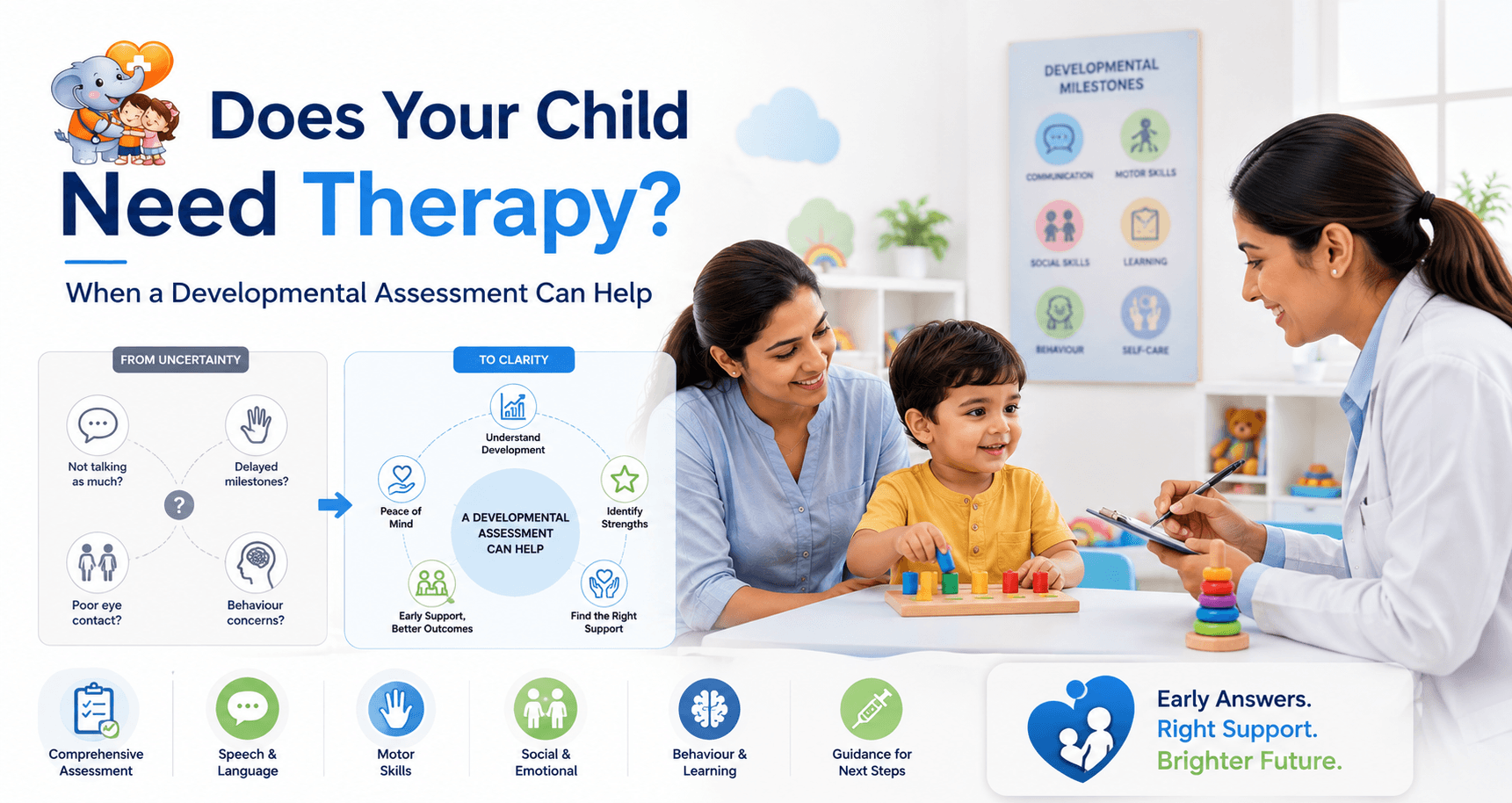
"My son isn't talking as much as other children his age. Should I be worried?"
"My daughter avoids eye contact sometimes. Does she need therapy?"
"My child is active all day. Is that normal or should I get an assessment?"
If questions like these have been on your mind, you're not alone. Almost every parent compares their child's development with other children at some point.
The good news is that not every developmental concern means your child needs therapy. Sometimes children simply develop at their own pace. Other times, a simple developmental assessment can provide reassurance—or identify areas where early support may help.
This is something we see often at Siraa Health. Many parents come to us looking for answers, and often, what they need most is clarity.
A developmental assessment for children is a structured evaluation that looks at how your child is growing across different areas such as:
An assessment does not automatically mean your child needs therapy.
Many children complete an assessment and continue developing normally with simple guidance and monitoring. Others may benefit from therapies such as speech therapy, occupational therapy, or behavioural support.
The goal is to understand your child's unique strengths and needs as early as possible.
Parents often notice small things before anyone else.
Maybe your toddler says only a few words.
Maybe they aren't interested in playing with other children.
Maybe they're taking longer to walk or don't respond consistently when their name is called.
Most parents wonder whether these are simply personality differences or signs that something needs attention.
This is something we hear almost every day at Siraa Health.
Get expert advice from Siraa Health doctors
The answer isn't to guess—it is to assess.
A developmental assessment is a child-friendly evaluation that checks whether your child is reaching age-appropriate milestones.
Rather than looking for a single diagnosis, it gives an overall picture of your child's development.
The assessment usually looks at:
Think of it as a health check-up—but for your child's development.
Yes.
Developmental assessments are not only for children with autism or developmental disorders.
Any child can have an assessment if parents have questions about development.
Some families also choose developmental assessments simply for peace of mind.
Examples include:
Many parents tell us they wish they had sought guidance sooner—not because something was seriously wrong, but because having answers reduced their anxiety.
Absolutely not.
This is probably the biggest misconception parents have.
Many developmental assessments end with reassurance rather than therapy.
Some children simply need:
Others may benefit from therapy for a short period.
Only some children require long-term intervention.
The purpose of the assessment is to understand what your child actually needs—not to recommend therapy unnecessarily.
While every child develops differently, some signs deserve a closer look.
These include:
One sign alone does not necessarily mean something is wrong, but a combination of concerns is worth discussing with a healthcare professional.
This is something we commonly evaluate at Siraa Health.
Parents are often surprised by how relaxed and play-based the assessment feels.
Rather than giving children tests, specialists observe how they naturally interact, communicate, and solve simple tasks.
The specialist observes how your child understands instructions, communicates needs, and interacts with others.
This includes vocabulary, pronunciation, sentence formation, and understanding language appropriate for your child's age.
Gross motor skills (running, jumping, climbing) and fine motor skills (drawing, stacking blocks, holding a spoon) are assessed.
Children learn through play. Specialists observe imagination, problem-solving, attention, and curiosity.
The assessment looks at eye contact, sharing attention, responding to others, and social communication.
Emotional regulation, attention span, flexibility, and everyday behaviours are reviewed.
| Developmental Assessment | Therapy |
|---|---|
| Evaluates development | Helps improve development |
| One-time or periodic assessment | Ongoing treatment sessions |
| Identifies strengths and concerns | Builds specific skills |
| Determines whether therapy is needed | Therapy begins only if required |
| Gives parents clarity | Supports developmental progress |
Many parents confuse assessment with treatment, but they are two different steps.
An assessment helps answer the question:
"Does my child need therapy?"
Therapy begins only if it is likely to benefit your child.
| Myth | Fact |
|---|---|
| Assessments are only for autism. | They evaluate all areas of child development. |
| Therapy is always recommended. | Many children only need monitoring and guidance. |
| Assessments are stressful. | Most assessments are play-based and child-friendly. |
| My child is too young. | Early assessments are often the most helpful. |
| Waiting is always better. | Early identification usually leads to better outcomes if support is needed. |
Most parents worry that an assessment will label their child.
In reality, it often provides reassurance and practical guidance.
Every child receives personalised recommendations.
Depending on the findings, your child's care plan may include:
| Concern | Assessment May Recommend |
|---|---|
| Mild speech delay | Home activities and follow-up |
| Moderate speech delay | Speech therapy |
| Delayed motor milestones | Occupational therapy or physiotherapy |
| Social communication concerns | Further developmental evaluation |
| Age-appropriate development | Reassurance and routine monitoring |
Sometimes, no therapy is needed at all.
Other times, starting therapy early can make learning easier and improve confidence over time.
Children's brains develop rapidly during the first few years of life.
This means early support can have a significant impact when it is needed.
Early assessment can:
The good news is that many developmental concerns respond well when identified early.
Book a developmental assessment if:
Remember, you know your child better than anyone else.
If your instincts tell you something deserves attention, it's always reasonable to seek professional guidance.
Every child develops in their own unique way, and comparing milestones with other children can sometimes create unnecessary worry.
A developmental assessment isn't about finding problems—it's about understanding your child's strengths, identifying areas where they may benefit from extra support, and giving you the confidence to make informed decisions.
At Siraa Health, we believe parents deserve clear answers, compassionate guidance, and care that is tailored to each child's individual journey.
Whether your child needs reassurance, simple home strategies, or therapy, taking the first step with an assessment can help you move forward with confidence.
| Category | Details |
|---|---|
| Suitable for | Children of all ages with developmental concerns |
| Assessment Duration | 45–90 minutes |
| Therapy Required After Assessment? | Not always |
| Who Performs the Assessment? | Developmental specialists and therapists |
| Best Age for Assessment | As soon as concerns arise |
| Purpose | Understand your child's strengths, identify developmental concerns, and determine whether additional support is needed |
A developmental assessment is not a diagnosis or a commitment to therapy.
It is the first step toward understanding your child's development.
Many children simply receive reassurance, while others benefit from early support that can make a lasting difference.