
Siraa Health
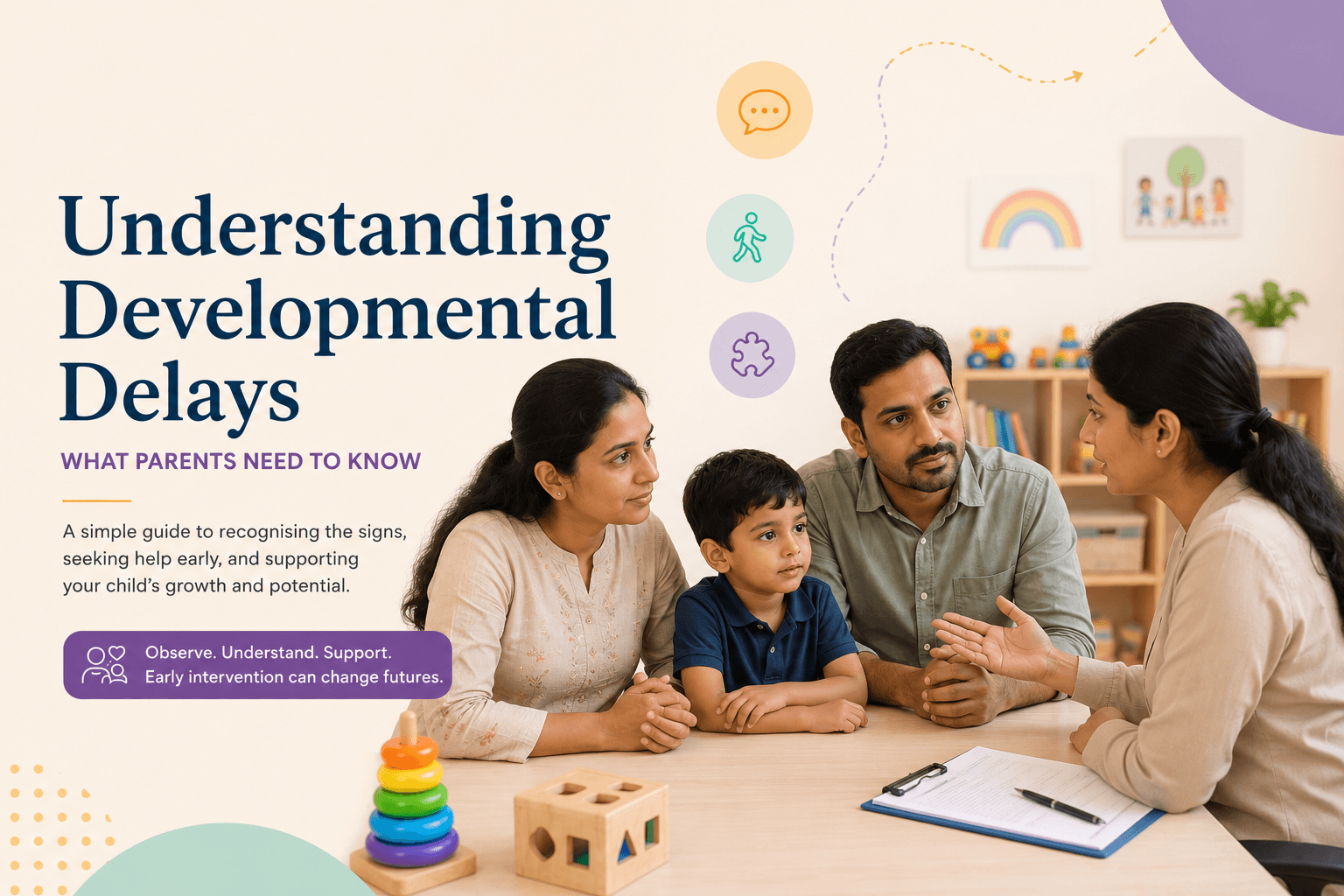
Have you ever found yourself comparing your child to another child at the park?
Maybe another toddler the same age is already speaking in sentences while your child uses only a few words. Maybe other children seem eager to join group activities while your child prefers to play alone.
Most parents worry about this.
You may wonder:
The good news is that children develop at different rates. Some children reach milestones earlier, while others take a little longer.
However, when delays affect communication, movement, learning, or social interaction, it may be worth looking more closely.
This is something we see a lot at Siraa Health. Many parents arrive feeling worried and leave feeling reassured after gaining a better understanding of their child's development.
A developmental delay happens when a child takes longer than expected to reach certain developmental milestones.
These milestones are skills that children typically learn as they grow.
Developmental delays can affect one area of development or several areas at the same time.
A developmental delay does not automatically mean there is a serious condition.
Many children benefit greatly from support and early intervention.
This is something we see a lot at Siraa Health. Early guidance often helps children build skills and confidence more quickly.
Developmental milestones are helpful markers that show how a child is growing and learning.
They help parents and healthcare professionals identify whether a child is developing as expected.
Examples include:
Examples include:
Examples include:
Examples include:
Every child develops differently.
However, significant delays in reaching these milestones may indicate that additional support could be helpful.
Understanding the different types of developmental delays can help parents identify areas where support may be needed.
Children may:
Speech delays are among the most common developmental concerns seen in young children.
Motor skills involve movement and coordination.
Signs may include:
Children may:
These delays affect learning, memory, and problem-solving skills.
Children may need extra support with understanding concepts or following instructions.
This is something we see a lot at Siraa Health. Parents are often surprised to learn that developmental delays can look very different from child to child.
Many parents wonder whether their child is simply developing at their own pace or experiencing a developmental delay.
The following comparison may help:
| Developmental Difference | Developmental Delay |
|---|---|
| Child reaches milestones slightly later | Child consistently misses multiple milestones |
| Progress continues steadily | Progress appears stalled |
| Skills improve naturally over time | Skills remain significantly behind peers |
| Variation within normal development | May require professional support |
| Child often catches up independently | Child may benefit from early intervention |
A developmental assessment can help determine whether additional support is needed.
There is not always a single cause.
Developmental delays can occur for many different reasons.
Sometimes no specific cause is identified.
The focus is not always on finding a cause but on helping your child build skills and confidence.
This is something we see a lot at Siraa Health. Parents often feel relieved when they learn that support can begin even before all the answers are known.
The first few years of life are a period of rapid brain development.
During this time, the brain has a remarkable ability to learn and adapt. This is called neuroplasticity (the brain's ability to form new connections and learn new skills).
Because young brains are so adaptable, early intervention can have a powerful impact.
This is something we see a lot at Siraa Health. Children often make meaningful progress when support begins early.
Consider speaking with a developmental paediatrician or child development specialist if:
You do not need to wait until concerns become severe.
Here's what to do: ask questions early.
Sometimes reassurance is all that's needed. Other times, early support can make a meaningful difference.
Many parents feel nervous about assessments.
The good news is that developmental assessments are usually straightforward and child-friendly.
A specialist may:
The goal is not to judge your parenting.
The goal is to better understand your child and identify ways to support their development.
Hearing the words "developmental delay" can feel overwhelming.
Most parents worry about what it means for their child's future.
The good news is that developmental delays do not define a child.
With understanding, patience, and the right support, many children make significant progress and continue to thrive.
If you have concerns about your child's development, trust your instincts and seek guidance. Sometimes one conversation can provide reassurance, and sometimes it can open the door to support that helps your child reach their full potential.
Every child develops differently, and every step forward matters.
Get expert advice from Siraa Health doctors