
Siraa Health
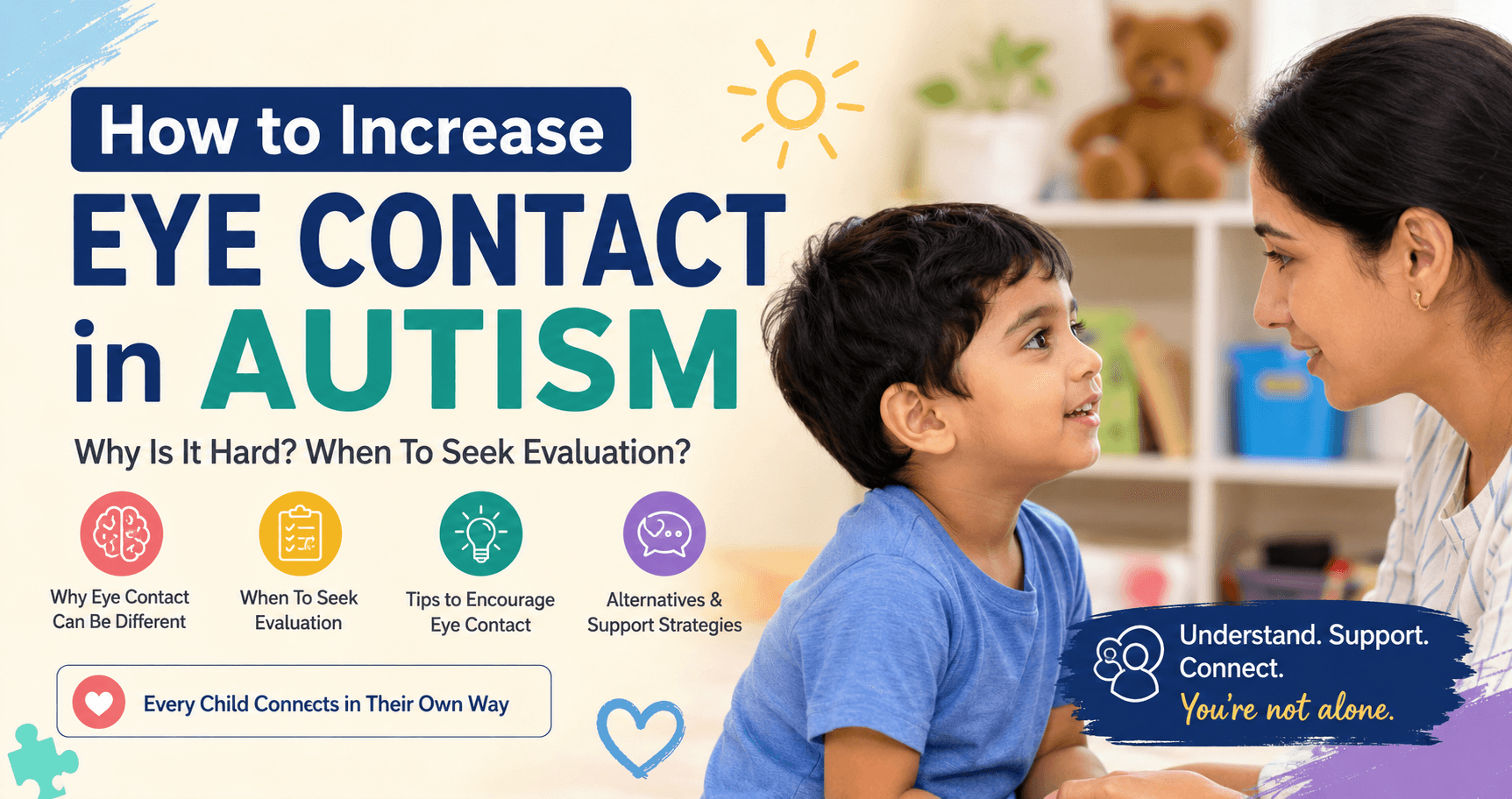
"My baby smiles, but doesn't look at me for very long."
"My toddler plays happily but avoids looking at me when I call their name."
"Everyone keeps telling me my child should make more eye contact. Should I be worried?"
These are some of the most common questions parents ask during developmental consultations.
Eye contact is one of the earliest ways babies connect with the people around them. It helps children learn language, understand emotions, and build relationships. When a child makes less eye contact than expected, it's natural for parents to wonder if something is wrong.
The good news is that every child develops differently. Some children naturally make less eye contact than others, and not every child who avoids eye contact has autism. However, reduced eye contact can sometimes be an early sign of a developmental difference, including Autism Spectrum Disorder (ASD).
This is something we see a lot at Siraa Health. Many parents come to us feeling anxious after hearing comments from family or searching online. Often, they simply need reassurance and a proper developmental assessment.
Let's understand why eye contact matters, why it can be different in autistic children, and how you can support your child's communication in a positive, pressure-free way.
Eye contact is when your child briefly looks at another person's face or eyes during everyday interactions.
It isn't about staring continuously. Instead, it's a natural part of communication.
Children use eye contact to:
For babies, eye contact begins long before they start speaking.
Every smile, peek-a-boo game, or feeding session helps strengthen these early social skills.
This is something we see a lot at Siraa Health. Parents often expect constant eye contact, but healthy eye contact is usually brief, natural, and happens during enjoyable interactions.
Many autistic children experience the world differently.
For some, making eye contact may feel uncomfortable, distracting, or overwhelming rather than natural.
Researchers believe this happens because autistic brains may process social information differently. Instead of helping communication, direct eye contact can sometimes require extra effort or even cause sensory discomfort.
This doesn't mean your child doesn't love you, isn't listening, or doesn't want to connect.
Many autistic children show affection and interest in ways other than looking directly into someone's eyes.
For example, your child may:
This is something we see a lot at Siraa Health. Parents sometimes mistake reduced eye contact for a lack of affection, when in reality their child may simply communicate differently.
No.
This is one of the biggest myths surrounding autism.
There are many reasons why a child may make less eye contact.
Some children are naturally shy.
Others may be tired, anxious, unwell, or simply focused on something more interesting.
Reduced eye contact may also be seen in children with:
The good news is that doctors never diagnose autism based on eye contact alone.
Instead, they look at your child's overall development, including:
This is something we see a lot at Siraa Health. Many children referred for poor eye contact are developing typically, while others benefit from early developmental support after a detailed assessment.
Every child develops at their own pace, but there are some general milestones that can help parents understand what to expect.
| Age | Typical Eye Contact and Social Interaction |
|---|---|
| Birth–2 months | Looks at parents' faces for short periods |
| 2–4 months | Smiles back and enjoys looking at familiar faces |
| 4–6 months | Makes eye contact during play and feeding |
| 6–9 months | Looks between people and toys, beginning to share attention |
| 9–12 months | Looks at parents when hearing their name and during games |
| 12–18 months | Uses eye contact while pointing, requesting, and interacting |
| 18–24 months | Frequently combines eye contact with gestures and early words |
Remember, these milestones are guides—not strict deadlines.
Some children may achieve them slightly earlier or later.
Parents sometimes become so focused on eye contact that they overlook all the other ways their child communicates.
Ask yourself:
These behaviours provide valuable information about your child's social development.
Eye contact is only one piece of a much bigger picture.
This is something we see a lot at Siraa Health. A child who doesn't make frequent eye contact may still communicate beautifully in many other ways.
Years ago, children were often encouraged to "look at me when I'm talking."
Today, we know that forcing eye contact isn't always beneficial, especially for autistic children.
For some children, maintaining eye contact while listening can actually make it harder to process what is being said.
Instead of helping communication, it may increase stress.
Rather than insisting on eye contact, focus on building enjoyable interactions where eye contact happens naturally.
The goal isn't to make your child look into your eyes all the time.
The goal is meaningful communication.
This is something we see a lot at Siraa Health. When parents remove pressure and make interactions playful, children often begin making more natural eye contact on their own.
Instead of asking your child to "look at me," create situations where looking at your face becomes fun and rewarding.
Here are a few ideas.
Sit on the floor or kneel so your face is naturally within your child's view.
Children are more likely to look at faces that are close to theirs.
If your child loves bubbles, toy cars, animals, or music, use those interests during play.
When you're part of something they enjoy, eye contact often happens naturally.
Blow bubbles.
Then pause.
Many children will briefly look at you to ask for "more."
That quick glance is meaningful social communication.
Celebrate it with a smile and continue playing.
Babies and young children love expressive faces.
Smile, laugh, sing songs, or play peek-a-boo.
These games encourage children to look toward your face without pressure.
Hold books close to your face while reading.
Pause before turning the page.
Your child may naturally glance toward you to see what happens next.
Eye contact doesn't need to last several seconds.
Even a quick glance during play is a wonderful step.
Praise shared moments with warmth rather than making eye contact the goal itself.
This is something we see a lot at Siraa Health. Small, joyful interactions repeated throughout the day are often far more effective than asking a child to "look at me."
Children learn best through play.
Rather than asking your child to "look at me," choose activities that naturally encourage them to look towards your face while having fun.
The goal isn't longer eye contact—it's creating meaningful moments of connection.
This is something we see a lot at Siraa Health. Children often make more eye contact when they're relaxed and enjoying themselves than when they're being asked to perform a task.
Peek-a-boo is one of the first social games babies enjoy.
As you uncover your face, pause for a moment before saying "Peek-a-boo!"
Your child may naturally look towards your face in anticipation.
Blow a few bubbles and then stop.
Hold the bubble bottle near your face and wait.
Many children will briefly look at you to ask for more.
That quick glance is an important communication skill worth celebrating.
Songs like If You're Happy and You Know It, Wheels on the Bus, or Twinkle Twinkle Little Star encourage children to look towards your face, especially when paired with exaggerated facial expressions and gestures.
Hide a favourite toy under a blanket.
Before revealing it, pause and smile.
Your child may naturally look at your face while waiting to see what happens next.
Choose books with colourful pictures.
Hold the book close to your face and change your voice for different characters.
Children often glance between the pictures and your expressions during story time.
If your child claps, clap too.
If they make a funny sound, copy it.
Imitating your child shows them that you're engaged, and many children begin looking towards your face during these playful interactions.
Eye contact is only one way children communicate.
Many autistic children connect with others using different but equally meaningful behaviours.
These include:
Instead of asking,
"Is my child making enough eye contact?"
it can be more helpful to ask,
"How is my child connecting with me?"
This shift in thinking helps parents appreciate the many ways children express love, curiosity, and trust.
This is something we see a lot at Siraa Health. Once parents begin noticing these small moments of connection, they often realise their child is communicating much more than they first thought.
One of the most important social skills is joint attention.
Joint attention means two people are focusing on the same thing together.
For example:
These shared moments help children develop:
Many autistic children develop joint attention differently or later than expected.
Supporting joint attention through play is often more helpful than simply encouraging eye contact.
Every child develops at their own pace.
Some babies are naturally quieter or make eye contact less often while still meeting all of their developmental milestones.
However, it's worth arranging a developmental evaluation if your child consistently:
Eye contact alone is not enough to diagnose autism.
Doctors always look at your child's overall development before making recommendations.
The good news is that early identification allows children to receive support sooner if they need it.
This is something we see a lot at Siraa Health. Parents often tell us they wish they hadn't waited because they were hoping their child would simply "grow out of it." If you're concerned, seeking an evaluation doesn't mean something is wrong—it means you're gathering information to support your child.
Many parents worry that an autism assessment will involve lots of medical tests.
In reality, the process is usually centred around observing how your child communicates, plays, and interacts.
During an evaluation, a developmental paediatrician may:
Sometimes, additional assessments with a speech therapist, psychologist, or occupational therapist may be recommended to better understand your child's strengths and support needs.
Remember, the goal of an evaluation is not to "label" your child.
It's to understand how they learn and communicate so they can receive the right support if needed.
If an evaluation identifies developmental differences, early support can make a meaningful difference.
Support is always tailored to each child's needs and may include:
Early support focuses on helping children build communication, social, and everyday life skills while respecting their individual strengths.
Many children make significant progress when families are involved and therapy begins early.
This is something we see a lot at Siraa Health. Parents often tell us that learning simple strategies to use at home gives them confidence and helps everyday interactions become more enjoyable.
If your child isn't making as much eye contact as you expected, it's understandable to feel worried.
The good news is that eye contact is only one part of how children communicate.
Some children naturally make less eye contact while still forming strong, loving relationships.
Others may benefit from a developmental evaluation and early support.
Instead of focusing on how often your child looks at you, look for the many ways they connect—through smiles, shared play, gestures, laughter, and spending time together.
Every child has their own way of communicating, and understanding those differences is the first step toward supporting them with confidence and compassion.
This is something we see a lot at Siraa Health. With the right guidance and early support when needed, parents often discover new ways to connect with their child and celebrate every milestone along the way.
Get expert advice from Siraa Health doctors