
Siraa Health
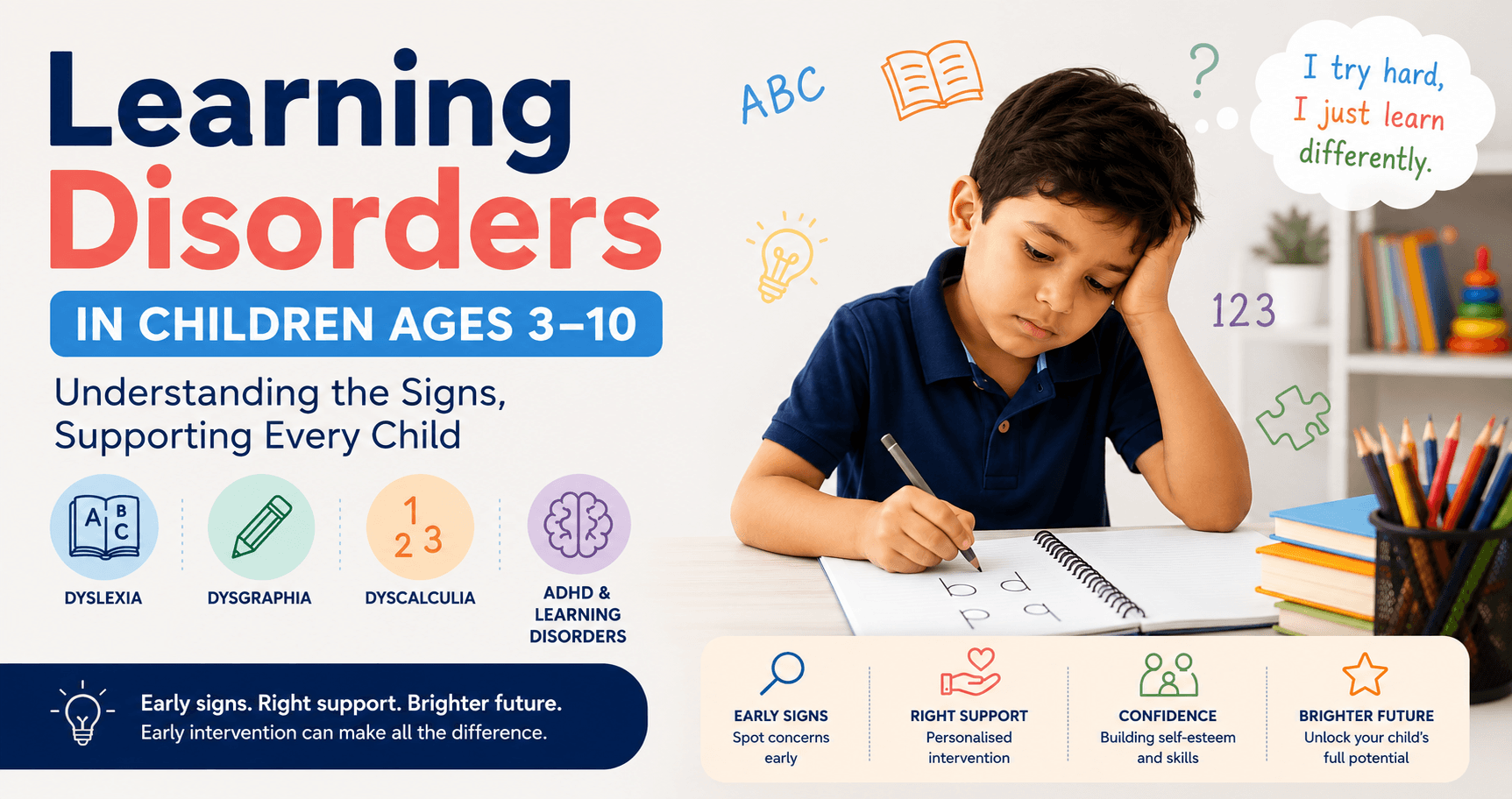
Have you ever watched your child spend an hour trying to read a single page while their classmates seem to breeze through it?
Or perhaps your child is bright, curious, and asks endless questions at home—but struggles to write simple words or remember basic maths at school.
Most parents wonder:
"Are they just taking a little longer to learn?"
Or...
"Could something else be going on?"
If these thoughts have crossed your mind, you're not alone.
Every child learns differently. Some learn by listening, some by watching, and others by doing. But when learning becomes consistently difficult despite normal intelligence, encouragement, and opportunities, it may be more than just a slower pace.
This is something we see a lot at Siraa Health. Many parents initially think their child is "lazy" or "not interested in studies," only to discover that their child has a learning disorder that simply needed to be recognised early.
The good news is that learning disorders are manageable, and children who receive early support often thrive both academically and emotionally.
Let's understand what they really are.
What Are Learning Disorders?
Learning Difficulty vs Learning Disorder vs Learning Disability
Common Types of Learning Disorders
Comparing Common Learning Disorders
How Learning Disorders Are Managed
Helping Your Child at Home
Supporting Your Child at School
Can Learning Disorders Be Cured?
Myths vs Facts About Learning Disorders
Frequently Asked Questions
Final Thoughts
A learning disorder is a condition that affects the way a child's brain receives, processes, stores, or responds to information.
This does not mean your child isn't intelligent.
In fact, many children with learning disorders have average or above-average intelligence.
Their brains simply process information differently.
For example, a child may understand a story perfectly when someone reads it aloud but struggle to read the same story themselves.
Another child may be excellent at science but find writing a simple paragraph extremely difficult.
These differences are known as Specific Learning Disorders (SLDs) because they affect specific academic skills rather than overall intelligence.
This is something we see a lot at Siraa Health. Parents are often relieved to learn that their child's struggles are not caused by a lack of effort—they simply learn differently.
These terms are often used interchangeably, but they don't mean the same thing.
| Feature | Learning Difficulty | Specific Learning Disorder | Learning Disability |
|---|---|---|---|
| What it means | Temporary challenges in learning | A diagnosed brain-based condition affecting specific academic skills | A broader term often used for intellectual or developmental disabilities |
| Cause | Illness, missed schooling, stress, language barriers | Differences in how the brain processes information | May involve lower intellectual functioning and adaptive skills |
| Can it improve? | Usually yes, with support | Yes, with specialised intervention and accommodations | Varies depending on the condition |
| Intelligence | Usually unaffected | Normal or above-average | May or may not be affected |
A child who has missed school because of illness may have learning difficulties, while a child with persistent reading problems despite good teaching may have a Specific Learning Disorder.
Understanding the difference helps ensure children receive the right support at the right time.
Every child is unique.
Some children struggle with reading.
Others find writing difficult.
Some have trouble understanding numbers or staying focused long enough to complete schoolwork.
Let's look at the most common learning disorders seen in children between the ages of 3 and 10.
Dyslexia is the most common learning disorder.
Children with dyslexia often have difficulty recognising letters, connecting letters to sounds, and reading words accurately.
You may notice your child:
Dyslexia does not affect intelligence.
Many successful entrepreneurs, scientists, artists, and leaders have dyslexia.
This is something we see a lot at Siraa Health. Once parents understand that reading difficulties aren't caused by laziness, they often become much more confident in supporting their child.
Some children know exactly what they want to say but struggle to put their thoughts onto paper.
This is called dysgraphia.
Children may:
Writing requires many skills to work together at the same time, including language, memory, planning, and fine motor coordination.
When one or more of these skills are affected, writing can become exhausting.
Children with dyscalculia struggle with understanding numbers and mathematical concepts.
They may:
Parents sometimes think their child simply "doesn't like maths."
In reality, the child's brain may process numbers differently.
Many parents ask:
"Is ADHD a learning disorder?"
The answer is no.
ADHD (Attention-Deficit/Hyperactivity Disorder) affects attention, focus, impulse control, and activity levels.
However, ADHD and learning disorders often occur together.
A child with ADHD may find it difficult to:
Some children have ADHD without a learning disorder.
Others have both conditions together.
Identifying both is important because each requires a slightly different approach.
| Condition | Main Difficulty | Common Signs |
|---|---|---|
| Dyslexia | Reading | Slow reading, spelling mistakes, letter confusion |
| Dysgraphia | Writing | Poor handwriting, slow writing, difficulty expressing ideas on paper |
| Dyscalculia | Maths | Difficulty counting, understanding numbers, telling time |
| ADHD | Attention and focus | Easily distracted, forgetful, impulsive, struggles to complete tasks |
One child may have just one of these conditions, while another may have more than one.
That is why every child benefits from an individual assessment rather than assumptions based on school performance alone.
There isn't a single medicine or quick fix for a learning disorder.
Instead, the focus is on understanding how your child learns best and giving them the right support at home, in school, and through targeted therapies when needed.
The good news is that many children with Specific Learning Disorders go on to excel in school, careers, sports, arts, and everyday life when their strengths are recognised early.
This is something we see a lot at Siraa Health. Once parents understand that success isn't about learning the same way as everyone else, they often feel much more hopeful about their child's future.
Parents play one of the biggest roles in building a child's confidence.
Small changes at home can make learning feel less stressful and much more enjoyable.
Children with learning difficulties often perform better when they know what to expect.
Try to:
A simple routine can reduce anxiety and improve focus.
Celebrate things like:
Confidence grows when children feel their effort is recognised.
Even 15–20 minutes of reading every day can strengthen vocabulary, comprehension and confidence.
Let your child choose books they enjoy.
You can build learning skills by:
Learning feels much less intimidating when it becomes part of everyday life.
Many children benefit from classroom accommodations such as:
These adjustments help children demonstrate what they know rather than struggle with how they learn.
Learning disorders don't need to be "cured."
They are lifelong differences in the way the brain processes information.
However, children can absolutely learn strategies that help them succeed.
With the right combination of:
...many children perform extremely well both academically and socially.
The goal isn't to change who your child is.
The goal is to help them learn in the way that suits them best.
| Myth | Fact |
|---|---|
| My child is just lazy. | Children with learning disorders often work harder than their peers but process information differently. |
| Learning disorders mean low intelligence. | Most children with Specific Learning Disorders have average or above-average intelligence. |
| Boys are the only children affected. | Learning disorders affect both boys and girls. |
| My child will eventually grow out of it. | Children improve with the right support but usually don't outgrow a learning disorder. |
| Good parenting can prevent learning disorders. | Learning disorders are brain-based conditions and are not caused by parenting style. |
| Asking for help will label my child. | Early assessment often reduces frustration and helps children receive the support they need. |
A: Some variation is completely normal. However, if your child continues to struggle despite regular practice, it's worth discussing your concerns with a developmental paediatrician.
A: No. ADHD affects attention and focus, while learning disorders affect specific academic skills such as reading, writing or maths. Some children have one condition, while others have both.
A: Yes. A child may have dyslexia and dysgraphia together or ADHD alongside a Specific Learning Disorder. A detailed educational assessment helps identify each area of difficulty.
A: Early signs may appear during preschool, but many learning disorders become more obvious once formal schooling begins. Assessments are commonly performed between the ages of 5 and 8.
A: Not at all. With early intervention, appropriate teaching strategies and family support, many children become confident learners and achieve excellent academic outcomes.
A: No. Excessive screen time can affect attention and sleep but does not cause dyslexia, dysgraphia or dyscalculia.
A: If your child continues to struggle with reading, writing, maths or attention despite consistent support, or if teachers repeatedly raise concerns, an educational assessment can provide valuable guidance.
Every child learns differently.
Some children learn best through reading.
Others understand better when they listen, watch or learn through hands-on experiences.
Having a learning disorder does not define your child's intelligence, creativity or future success.
What makes the biggest difference is recognising challenges early, providing the right support and celebrating progress along the way.
This is something we see every day at Siraa Health. When parents, teachers and healthcare professionals work together, children often surprise everyone with what they are capable of achieving.
If you're concerned about your child's learning, trust your instincts. Asking questions early doesn't mean something is wrong—it simply gives your child the best opportunity to thrive.
Get expert advice from Siraa Health doctors