
Siraa Health
Have you ever found yourself saying:
"I've told you five times already!"
Or maybe your child has just thrown a tantrum in the middle of the supermarket, hit their sibling, or refused to listen when it was time to leave the playground.
In that moment, it's easy to wonder:
Most parents worry about this.
Every parent wants to raise a kind, respectful, and responsible child. But knowing how to respond to challenging behaviour isn't always easy.
Many of us were raised believing that punishment teaches discipline. Today, we know much more about how children's brains develop and how they learn from the adults around them.
The good news is that discipline doesn't have to involve fear, shouting, or harsh consequences.
Positive discipline helps children understand expectations while also teaching emotional regulation, responsibility, and problem-solving.
This is something we see a lot at Siraa Health. Parents often feel caught between being "too strict" and "too lenient," when the most effective approach is usually somewhere in the middle.
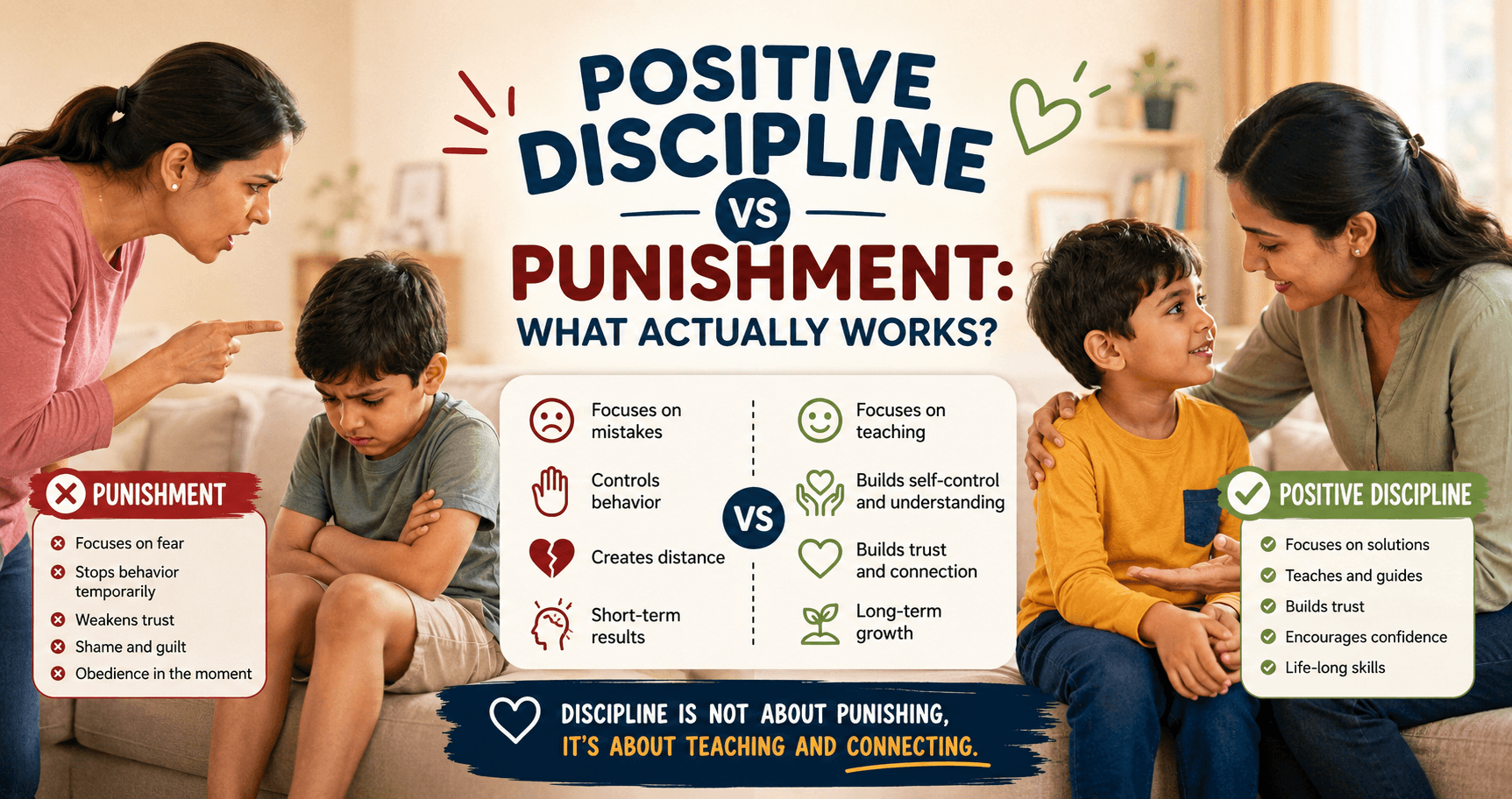
Positive discipline is a parenting approach that focuses on teaching rather than punishing.
Instead of asking:
"How do I stop this behaviour?"
Positive discipline asks:
"What is my child trying to learn, and how can I guide them?"
The goal isn't simply to make a child obey in the moment.
The goal is to help them develop lifelong skills such as:
Children aren't born knowing how to manage frustration, share toys, or wait patiently.
These are skills that develop over time with guidance, consistency, and practice.
This is something we see a lot at Siraa Health. Challenging behaviours often become opportunities to teach important life skills rather than moments that require punishment.
Punishment focuses on stopping unwanted behaviour through fear or unpleasant consequences.
Examples include:
Punishment may stop a behaviour temporarily.
However, it doesn't always teach children what they should do instead.
For example, if a child hits another child and is shouted at, they may learn that hitting leads to adults becoming angry.
They may not learn healthier ways to manage frustration.
Although these approaches may seem similar, they have very different goals.
| Positive Discipline | Punishment |
|---|---|
| Teaches appropriate behaviour | Focuses on stopping behaviour |
| Builds trust | Often creates fear |
| Encourages problem-solving | Encourages avoidance |
| Helps children learn self-control | Relies on adult control |
| Builds confidence | May reduce confidence |
| Strengthens parent-child relationships | Can damage communication |
Positive discipline does not mean allowing children to do whatever they want.
Children still need boundaries.
The difference is how those boundaries are taught.
Imagine your child spills a glass of milk while trying to help set the table.
If they are shouted at, they may become afraid of helping again.
If they are calmly shown how to clean the spill and encouraged to try again, they learn responsibility without fear.
Research consistently shows that children learn best when they feel safe, understood, and supported.
Punishment may create immediate obedience, but it often doesn't teach lasting behaviour.
This is something we see a lot at Siraa Health. Children who understand why a behaviour is expected are more likely to repeat it than children who obey only because they fear consequences.
One of the biggest parenting myths is that children misbehave simply to be "naughty."
In reality, behaviour is often communication.
Children may act out because they are:
Young children have immature brains.
The part of the brain responsible for planning, impulse control, and decision-making continues developing well into early adulthood.
That means children often need guidance rather than punishment.
Instead of asking:
"Why is my child behaving like this?"
Try asking:
"What might my child be trying to tell me?"
This simple shift often changes how parents respond.
One of the biggest misconceptions about gentle parenting is that it means saying "yes" to everything.
It doesn't.
Gentle parenting combines warmth with clear expectations.
For example:
"Stop crying right now!"
"I can see you're upset. It's okay to feel angry, but it's not okay to hit."
Notice the difference.
Children need both empathy and structure.
This is something we see a lot at Siraa Health. Parents often discover that staying calm actually helps children calm down faster than raising their voice.
It's easy to focus on today's behaviour.
But parenting is really about preparing children for adulthood.
Ask yourself:
Positive discipline focuses on building these lifelong skills one small interaction at a time.
Positive discipline doesn't mean having the perfect response every time.
It means helping your child learn from mistakes while feeling safe, respected, and supported.
Here are some practical strategies that many families find helpful.
Children feel more secure when they know what is expected of them.
Keep rules simple, age-appropriate, and consistent.
"Behave yourself."
"We use gentle hands."
Or:
"We walk inside the house."
Clear expectations are much easier for children to understand than vague instructions.
This is something we see a lot at Siraa Health. Children are more likely to cooperate when they know exactly what is expected.
Children naturally repeat behaviours that receive positive attention.
Instead of focusing only on mistakes, notice the moments when your child does something well.
For example:
Specific praise helps children understand which behaviours are encouraged.
When your child is overwhelmed, they borrow your calm.
If you shout, the situation often becomes more intense.
Instead:
For example:
"I know you're upset because we have to leave the park. It's okay to feel disappointed. I'm here with you."
This doesn't mean giving in.
It means helping your child move through big emotions safely.
Children make mistakes because they are still learning.
Imagine your child throws a toy because they're angry.
"You're a bad boy."
"Throwing toys can hurt people. Let's find another way to show you're angry."
Correct the behaviour without labelling the child.
Children should believe:
"I made a mistake."
—not—
"I am a bad person."
Children often cooperate better when they feel they have some control.
"Put your shoes on now."
"Would you like to wear the blue shoes or the red shoes?"
The boundary remains the same, but your child feels involved in the decision.
Natural consequences help children connect actions with outcomes.
For example:
Natural consequences often teach responsibility more effectively than unrelated punishments.
Seeing your child hit, bite, kick, or push someone can be upsetting.
Most parents immediately wonder how to stop the behaviour.
The first step is understanding why it happened.
Aggression in young children often comes from:
For example:
"I won't let you hit. I can see you're very angry. Let's take some deep breaths together."
Over time, children learn healthier ways to express themselves.
This is something we see a lot at Siraa Health. When parents respond consistently, aggressive behaviours often become less frequent.
Every parent makes mistakes.
The goal isn't perfection.
It's learning and growing alongside your child.
If you ask ten times before acting, children learn that your first nine requests don't matter.
Children remember how we made them feel more than the exact words we used.
Taking a few seconds to calm yourself can completely change the outcome.
A two-year-old cannot behave like a six-year-old.
Understanding age-appropriate behaviour helps reduce frustration for everyone.
Every child develops differently.
Comparing siblings or classmates often creates unnecessary pressure.
Focus on your child's individual progress.
Children learn through repetition.
If rules change every day, they become confusing.
Consistency builds security.
Some challenging behaviours are a normal part of child development.
However, it may be helpful to seek professional guidance if your child's behaviour:
Here's what to do: Trust your instincts.
Most parents worry about asking for help too early.
In reality, seeking guidance is often one of the most helpful things you can do for your child.
This is something we see a lot at Siraa Health. Early support often helps families understand behaviour before it becomes more stressful.
Every child will have moments of anger, frustration, tears, and challenging behaviour.
That's part of growing up.
The goal of discipline isn't to create perfect children.
It's to raise children who understand:
Positive parenting doesn't mean saying yes to everything.
It means setting clear boundaries while helping your child feel understood and supported.
Some days will be harder than others.
That's okay.
Parenting isn't about getting every moment right.
It's about showing up consistently, learning together, and helping your child develop the skills they'll carry for life.
Every calm conversation, every boundary, and every moment of connection is helping shape your child's future.
A: They are closely related. Both focus on teaching children with empathy, respect, and consistency rather than fear or punishment. Positive discipline places particular emphasis on helping children learn life skills while maintaining clear boundaries.
A: No. Positive parenting still involves rules and boundaries. The difference is that limits are explained calmly and consistently, helping children understand why they exist.
A: Not at all. Children benefit from structure, consequences, and guidance. Positive discipline teaches responsibility without relying on fear or shame.
A: Stay calm, acknowledge your child's feelings, keep everyone safe, and avoid arguing during the tantrum. Once your child is calm, talk about what happened and teach better ways to express emotions.
A: Time-outs can be helpful when used calmly and appropriately, but they should not be used as a form of humiliation or isolation. Many parents also find "time-ins," where they stay with their child to help them regulate emotions, to be effective.
A: Make sure instructions are short, clear, and age-appropriate. Consistency, routines, and positive reinforcement often improve cooperation over time. If difficulties are severe or persistent, consider speaking with a healthcare professional.
A: If behaviour is causing significant stress at home, affecting school, leading to aggression, or making daily life difficult, it's worth discussing your concerns with a paediatrician or child development specialist.
Get expert advice from Siraa Health doctors