
Siraa Health
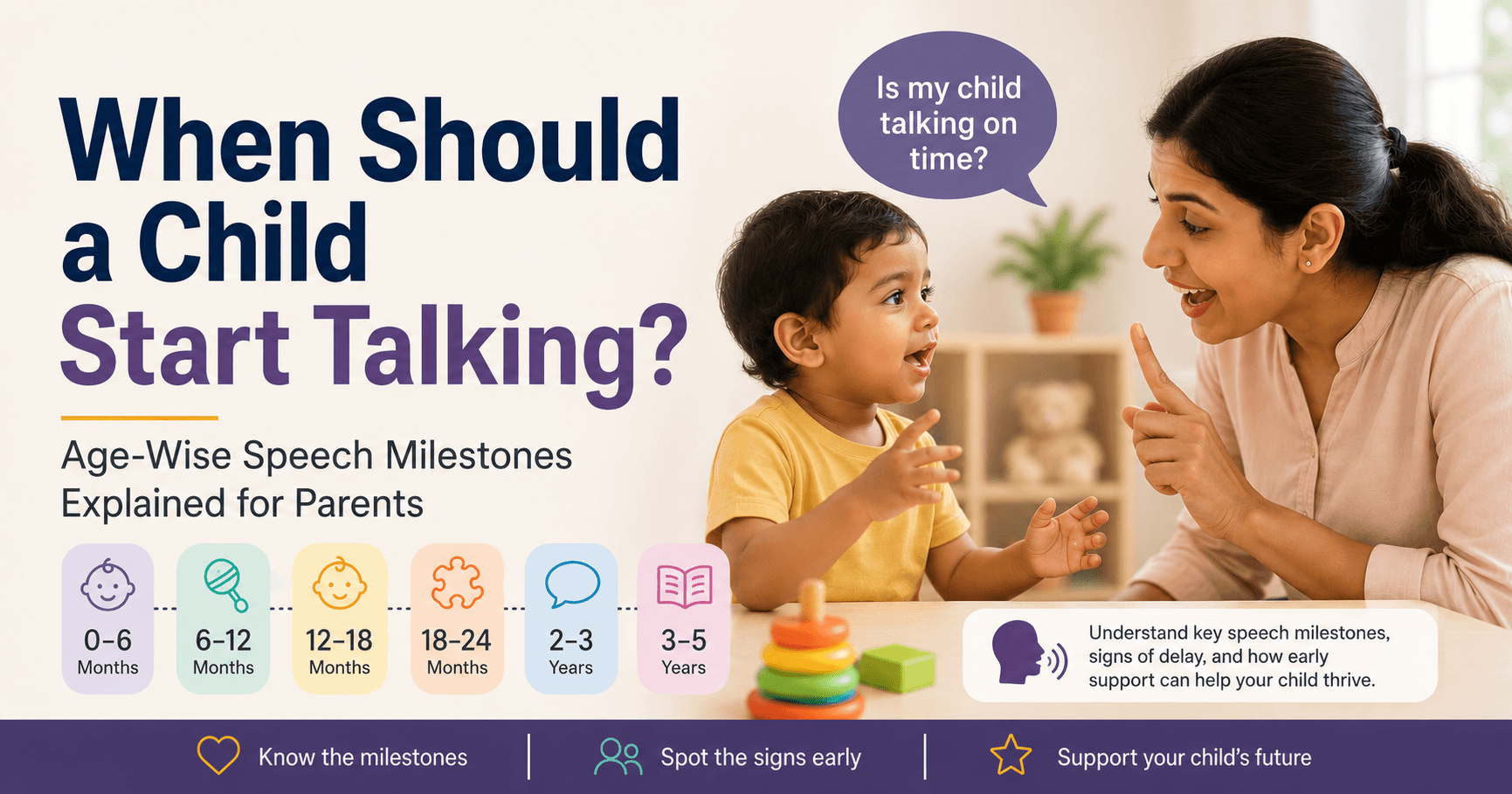
Have you ever been at a birthday party and noticed another child your toddler's age chatting away while your child says very little?
Or maybe a grandparent has asked, "Shouldn't they be talking more by now?"
Most parents worry about this.
Questions about speech and language development are among the most common concerns parents have during the early years.
You may find yourself wondering:
The good news is that children develop at different speeds.
Some children start talking earlier, while others take more time.
However, understanding age-wise speech milestones can help you recognise when your child is progressing as expected and when additional support may be helpful.
This is something we see a lot at Siraa Health. Many parents feel reassured once they understand what speech development typically looks like at different ages.
Communication is one of the most important skills children develop.
Speech helps children express their needs, build relationships, learn at school, and gain confidence.
Language development includes:
Speech is the ability to produce sounds and words.
Language is the ability to understand and use those words meaningfully.
This is something we see a lot at Siraa Health. Parents are often surprised to learn that a child can have strong language skills even if speech is still developing.
Every child develops differently, but there are common milestones that most children achieve within a certain age range.
At this stage, your baby is already learning the foundations of communication.
Typical milestones include:
These early interactions help build future language skills.
Babies become much more vocal during this period.
Common milestones include:
By around 12 months, many babies say their first meaningful word.
This is something we see a lot at Siraa Health. Parents often mistake babbling as meaningless sounds, but it is actually an important part of speech development.
Communication skills continue to grow rapidly.
Most children may:
Children understand far more words than they can speak at this age.
Language growth often accelerates during this period.
Many children:
Examples may include:
This is often the age when parents first become concerned about speech delay if communication is limited.
Speech becomes easier for family members to understand.
Children may:
Most children continue learning new words every week.
Communication becomes more complex.
Children often:
Speech should be understandable most of the time.
By this age, many children communicate similarly to adults in everyday conversations.
Typical milestones include:
Every child develops at their own pace, but these milestones provide useful guidance.
Many parents wonder whether their child is simply taking their time or experiencing a speech delay.
The following comparison may help.
| Typical Development | Possible Speech Delay |
|---|---|
| Babbling by 6–9 months | Limited or no babbling |
| Responds to name | Rarely responds to name |
| Uses words by 12–18 months | Few or no words by 18 months |
| Combines words by 2 years | Not combining words by 2 years |
| Follows simple instructions | Difficulty understanding language |
| Steady vocabulary growth | Very slow progress over time |
A developmental assessment can help provide clarity if you are unsure.
Speech delay can occur for many different reasons.
Some possible causes include:
Children learn language by listening.
If hearing is reduced, speech development may be affected.
Broader developmental delays can sometimes affect communication skills.
Some autistic children experience speech and language delays.
Others may develop language differently.
Children learn language through interaction, conversation, and play.
These are difficulties coordinating the muscles used for speech.
This is something we see a lot at Siraa Health. Many parents assume speech delay has one cause, but several factors can influence communication development.
You play a huge role in your child's language development.
Describe everyday activities.
For example:
Simple language exposure helps build vocabulary.
Books introduce new words and concepts.
Even ten minutes a day can make a difference.
Talk about what your child is looking at or playing with.
Children learn best when they are engaged.
Children learn language best through real-life interaction.
Conversations are far more effective than watching videos alone.
Avoid answering for them immediately.
Pause and give them opportunities to communicate.
This is something we see a lot at Siraa Health. Small changes in daily interactions often create meaningful improvements over time.
Many parents wonder whether they should wait.
The good news is that early support can be incredibly effective.
The first few years of life are a period of rapid brain development.
Early intervention may help:
Seeking guidance early does not mean something is wrong.
It simply means giving your child every opportunity to succeed.
Consider speaking with a healthcare professional if:
Here's what to do: trust your instincts and ask questions.
Parents are often the first people to notice subtle differences.
This is something we see a lot at Siraa Health. Early conversations often provide reassurance, guidance, and practical next steps.
Watching your child learn to communicate is one of the most rewarding parts of parenting.
While milestone charts can be helpful, remember that every child develops differently.
The good news is that many children with speech delays make excellent progress with the right support and encouragement.
If you are concerned about your child's communication, trust your instincts and seek guidance. Sometimes reassurance is all that's needed. Sometimes early support can make a meaningful difference.
Every word, every sound, and every conversation is a step forward in your child's journey.
Get expert advice from Siraa Health doctors