Siraa Health
"My baby is 10 months old but isn't saying any words yet. Is that normal?"
"My 18-month-old understands everything but hardly speaks. Should I be worried?"
"My child is almost 2 and only says a few words. Does this mean they need speech therapy?"
These are questions many parents ask, especially when they see another child of the same age talking more.
The good news is that speech and language development happens gradually. Babies communicate long before they say their first words through sounds, gestures, facial expressions, pointing, looking, and responding to people.
Developmental milestones are useful guides, but they are not deadlines. Children can reach individual milestones at slightly different times. ASHA also recommends looking at a range of skills rather than judging development based on one milestone alone.
This is something we see often at Siraa Health. Parents sometimes worry about the number of words their child says without realising that understanding, gestures, interaction, and communication are equally important.
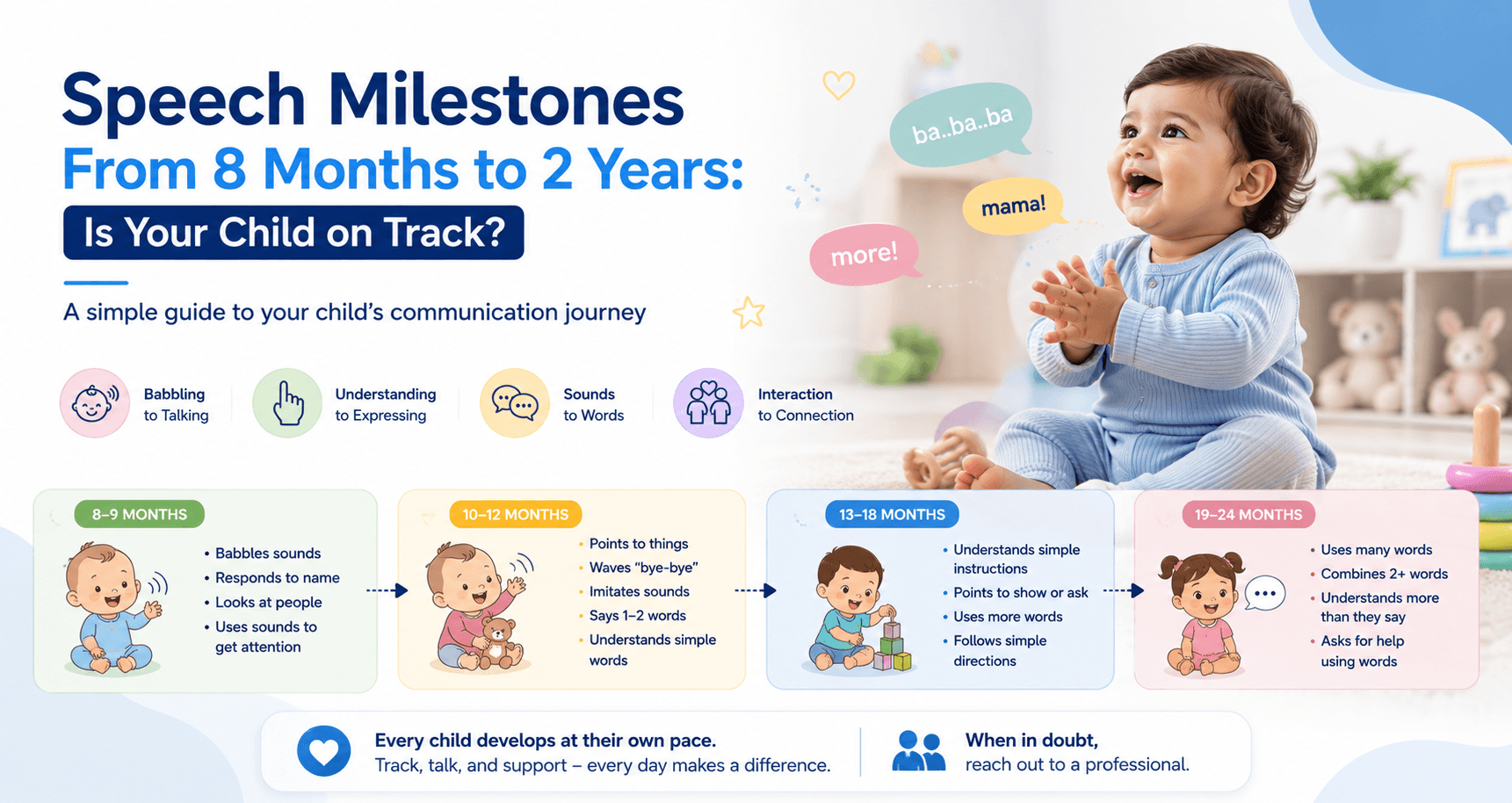
Between 8 months and 2 years, children typically move from babbling and responding to familiar voices toward using gestures, understanding simple instructions, saying meaningful words, and eventually combining two or more words.
Here's a simple overview:
| Age | Communication Milestones to Look For |
|---|---|
| 8–9 months | Babbles, responds to their name, looks toward familiar people and sounds |
| 10–12 months | Waves, points, imitates sounds and gestures, may say one or two meaningful words |
| 13–18 months | Understands simple instructions, points to communicate, uses increasing numbers of words |
| 19–24 months | Uses and understands many words and begins combining two or more words |
These are broad developmental ranges rather than strict deadlines. ASHA notes that children develop uniquely and recommends professional assessment when a child is missing several skills, not learning new skills, or losing skills they previously had.
When parents hear "speech development," they often think only about talking.
But communication is much bigger than words.
Your baby's communication includes:
ASHA describes communication milestones across hearing, speech, and language because children develop these skills together.
This is something we see a lot at Siraa Health: a child may have very few spoken words but communicate effectively through gestures, sounds, pointing, and understanding.
Between 8 and 12 months, your baby is becoming an increasingly active communicator.
You may notice your baby:
Babbling at this age is an important step toward later speech.
ASHA lists long strings of babbling sounds among communication milestones around 7–9 months.
As your baby approaches their first birthday, communication often becomes more purposeful.
They may:
CDC's 12-month milestones also include waving "bye-bye," calling a parent by a special name such as "mama" or "dada," and understanding "no."
This is often an exciting period for parents because your child's understanding and use of language can grow quickly.
Your child may:
ASHA specifically highlights following simple directions, pointing to communicate, using gestures, and understanding and using words for familiar people and objects during the 13–18 month period.
Look at the whole communication picture.
Does your child understand what you say? Do they point? Do they use gestures? Do they imitate sounds? Do they try to communicate what they want?
A child with fewer spoken words but good understanding and social communication may have a different developmental profile from a child who has limited words and limited communication in other areas.
If you have concerns, an assessment can help clarify what's happening rather than relying on word counts alone.
The second year is often when language begins to expand rapidly.
By around 19–24 months, many children:
ASHA's 19–24 month communication milestones include using and understanding at least 50 different words and putting two or more words together, although individual development varies.
For example:
"More water."
"Mama come."
"Go outside."
"Want ball."
Speech may still be unclear at this age. That's normal. Children are still learning how to coordinate sounds and words.
| Age | What You May Notice | What You Can Do |
|---|---|---|
| 8–9 months | Babbling, responding to name, social sounds | Copy their sounds and respond |
| 10–12 months | Pointing, waving, imitation, 1–2 words | Name objects and use gestures |
| 13–18 months | More words, following simple instructions | Talk through daily activities |
| 19–24 months | Growing vocabulary, two-word combinations | Expand what your child says |
Remember, milestones describe patterns seen in groups of children. They aren't a test your child has to "pass" on a particular birthday.
You don't need expensive toys or special equipment to support language.
Your everyday interactions are some of the best opportunities for learning.
Tell your child what you're doing.
"Let's wash your hands."
"Here's your cup."
"Let's put your shoes on."
This helps your child connect words with actions and objects.
If your child is playing with a car, talk about the car.
"Red car."
"Car goes."
"Fast car."
Following their attention makes communication more meaningful.
You don't need to finish the whole book.
Point at pictures and name them.
"Dog."
"Where's the dog?"
"Dog is running."
ASHA recommends reading and talking about pictures as part of supporting communication development.
Don't immediately answer for your child.
Ask a simple question, pause, and give them time to respond with a word, sound, gesture, or look.
If your family speaks more than one language, you do not need to stop using your home language to encourage speech.
ASHA specifically states that families can communicate with children in the languages they are most comfortable using and that learning multiple languages does not cause speech or language problems.
Not every child who talks later has a developmental disorder.
However, certain patterns deserve closer attention.
Consider seeking professional guidance if your child:
A loss of previously acquired skills is particularly important to discuss with your child's doctor. ASHA advises families to seek guidance when children lack several expected skills, are not learning new skills, or lose skills they previously had.
No.
An assessment is the best way to understand why your child's speech or communication may be developing differently.
Depending on the findings, your child may need:
The right approach depends on the reason behind the communication concern, not simply the number of words your child says.
Hearing plays an important role in speech and language development.
Sometimes a child appears not to be talking because they are having difficulty hearing certain sounds or speech clearly.
If you notice that your child doesn't consistently respond to sounds or their name, frequently asks for repetition as they get older, or you have any concerns about hearing, speak with your child's doctor about whether hearing evaluation is appropriate.
The American Academy of Pediatrics recommends prompt hearing assessment when signs of hearing changes appear.
You don't have to wait until your child turns two—or older—to ask for help.
Consider seeking professional guidance if you're concerned about your child's communication at any age.
It's particularly worth discussing if your child:
Most parents worry that asking for an assessment means their child will immediately be started on therapy.
That's not necessarily the case.
An assessment is first about understanding your child.
| Speech Milestones | Speech Therapy |
|---|---|
| Help parents understand typical development | Provides targeted professional support |
| Show skills that commonly emerge with age | Works on specific communication goals |
| Can be monitored at home | Usually involves structured sessions |
| Don't diagnose a speech disorder | Begins when assessment indicates support may help |
| Vary from child to child | Is personalised to the child's needs |
Developmental milestones are a guide, not a diagnosis. ASHA also states that its milestone resources are not intended to be screening or diagnostic tools.
Your baby's first words are exciting, but speech development begins long before those first words appear.
Every babble, gesture, point, shared smile, copied sound, and attempt to communicate is part of your child's journey toward language.
If your child isn't meeting every milestone exactly when you expected, don't panic. Look at the bigger picture and watch whether your child is continuing to learn and communicate.
And if something doesn't feel right, you don't have to wait and wonder.
A conversation with your paediatrician or a speech-language professional can give you clarity about what your child is doing well, where they may need support, and what you can do next.
At Siraa Health, this is something we see often: parents don't necessarily need an immediate therapy plan—they need someone to listen, assess their child's development, and help them understand the next step.
Get expert advice from Siraa Health doctors