
Siraa Health
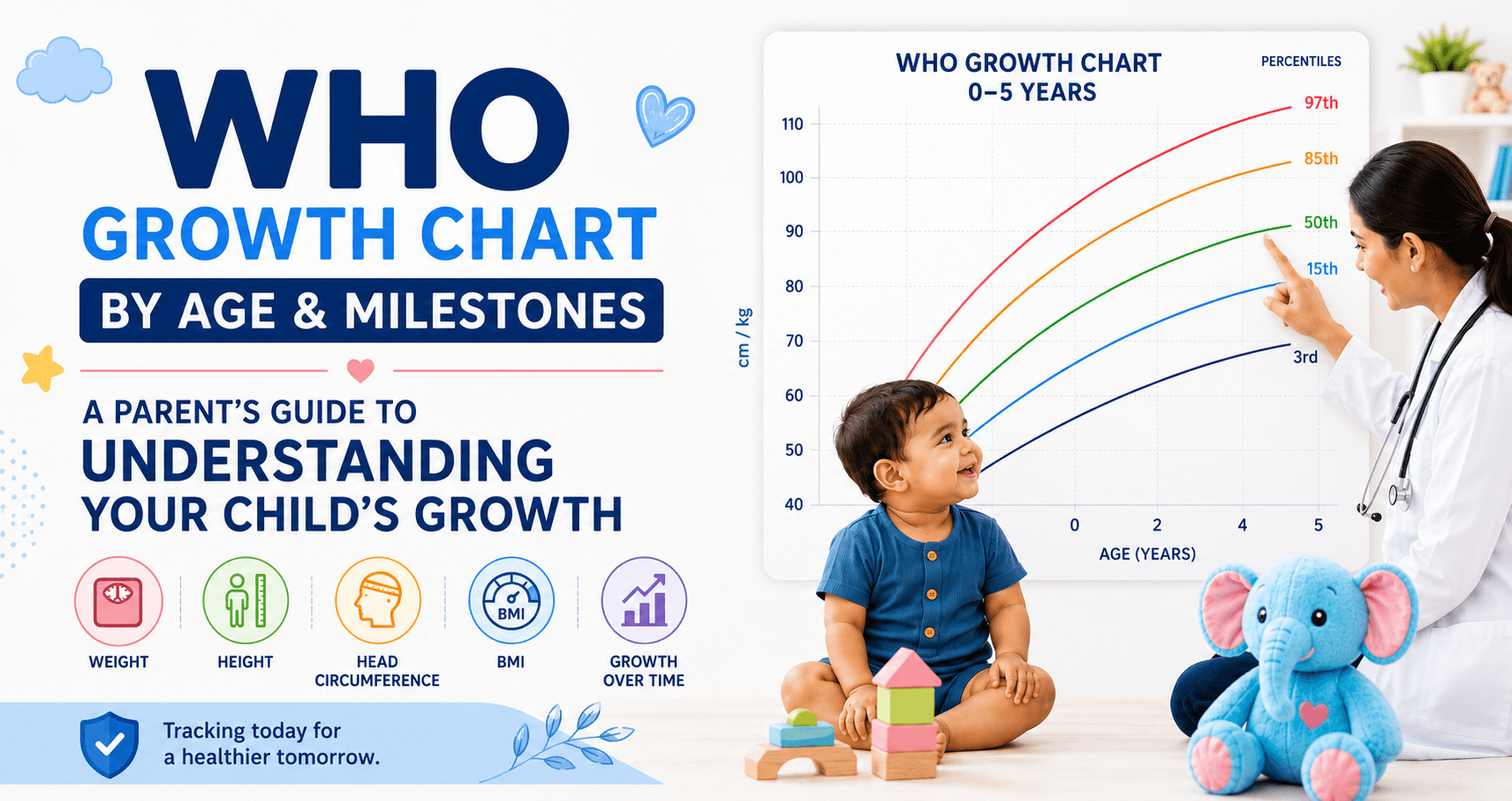
Have you ever left your child's vaccination appointment wondering what all those curved lines on the growth chart actually mean?
Maybe your paediatrician said,
"Your child is in the 25th percentile."
…and you immediately wondered:
If you've searched the internet, you've probably found confusing numbers, charts, and medical terms that only made things more overwhelming.
Most parents worry about this.
The good news is that a growth chart is not a report card.
It is simply a tool that helps doctors understand how your child is growing over time.
This is something we see a lot at Siraa Health. Parents often arrive worried after comparing their child with cousins, neighbours, or online charts, only to discover that their child's growth is completely healthy.
Let's break it down in simple language.
The World Health Organization (WHO) created growth standards using data from thousands of healthy children around the world.
These standards show how children are expected to grow under healthy conditions, rather than how an average child grows.
Doctors use WHO growth charts from birth until five years of age to monitor whether children are growing consistently.
These charts help monitor:
Rather than looking at a single measurement, doctors look at the pattern of growth.
This is something we see a lot at Siraa Health. Parents often focus on one number, while doctors are much more interested in whether growth is following a steady pattern.
Every child is unique.
Some children are naturally taller.
Some are naturally smaller.
Some gain weight quickly.
Others grow more gradually.
Growth charts help answer one simple question:
"Is my child growing consistently for them?"
Instead of comparing your child with another child at daycare or in your family, growth charts compare your child with internationally recognised WHO standards.
Growth monitoring helps identify:
Most importantly, they help doctors identify concerns before they become bigger problems.
This is the part that confuses parents the most.
Let's make it simple.
Imagine 100 healthy children standing in a line from shortest to tallest.
If your child is in the 50th percentile, they are right in the middle.
Now imagine your child is in the 15th percentile.
That simply means:
It does not automatically mean your child is unhealthy.
Likewise, being in the 97th percentile does not automatically mean your child is healthier.
Percentiles simply describe where a child falls compared with other healthy children of the same age and sex.
One of the biggest misconceptions is that every child should be around the 50th percentile.
That isn't true.
Healthy children can naturally fall anywhere across the growth chart.
What matters most is consistent growth over time.
| Percentile | What It Means | Usually Normal? |
|---|---|---|
| Below 3rd | Smaller than most children | Needs medical review |
| 3rd–15th | Smaller than average | Often completely healthy |
| Around 50th | Average | Yes |
| 85th | Larger than average | Usually healthy |
| Above 97th | Larger than most children | May require evaluation depending on growth pattern |
A child who has always been around the 15th percentile and continues growing steadily may be perfectly healthy.
A child who suddenly drops from the 75th percentile to the 10th percentile deserves further assessment.
This is something we see a lot at Siraa Health. It is often the change in the growth curve, not the percentile itself, that provides the most valuable information.
Many parents assume that if a child is gaining weight, everything is developing normally.
Growth and development are related—but they are not the same.
A child may have completely normal growth but still need support with developmental milestones.
Likewise, a child with slower weight gain may be developing beautifully in every other area.
This is why paediatricians always assess both growth and development during routine visits.
Every routine check-up usually includes four important measurements.
Together, they provide a much clearer picture than weight alone.
This shows whether your child is gaining weight appropriately for their age.
It can help identify:
Weight is one of the earliest indicators that something may need closer attention.
Height reflects long-term growth.
Children who consistently grow much slower than expected may need further evaluation.
Height can be influenced by:
One measurement is rarely enough.
Doctors prefer to monitor height over several months to identify patterns.
During the first two years of life, your baby's brain grows rapidly.
Measuring head circumference helps doctors monitor healthy brain growth.
A head that grows too slowly—or too quickly—may require additional evaluation.
Fortunately, many variations are completely normal, especially when they run in families.
For older children, doctors may also calculate BMI (Body Mass Index).
BMI compares height and weight together.
Unlike adults, children's BMI is interpreted using age-specific percentiles rather than a single number.
BMI helps identify:
It is only one part of the overall picture and should never be interpreted in isolation.
One of the biggest myths we hear is:
"My child is smaller than everyone else. Will that affect learning?"
The answer is not necessarily.
Growth charts measure physical growth.
They do not measure:
Children grow in many different ways, and every child follows their own unique path.
This is something we see a lot at Siraa Health. Once parents understand what growth charts are really designed to do, much of the anxiety around percentile numbers begins to fade.
One of the most common questions parents ask is,
"What should my child be able to do at this age?"
The truth is that milestones are guides, not deadlines.
Some children walk a little earlier.
Some begin talking a little later.
Some are naturally more social, while others take time to warm up.
What doctors look for is steady progress over time, not perfection.
This is something we see a lot at Siraa Health. Parents often compare their child with another child of the same age, but every child follows their own unique developmental journey.
Your baby's world is all about bonding, feeding, and learning to interact.
Your baby becomes much more curious about the world.
This is something we see a lot at Siraa Health. Around this age, babies begin showing their own unique personalities.
This is an exciting period of rapid learning.
Many babies become much more independent.
Your toddler is becoming much more active.
This is something we see a lot at Siraa Health. Parents often worry about speech during this stage because communication develops at different rates.
Language development usually accelerates.
Children become much more independent.
Confidence grows rapidly.
Children prepare for school.
This is something we see a lot at Siraa Health. By five years, differences between children often become easier to recognise, making developmental assessments especially valuable when concerns exist.
Rather than aiming for a specific percentile, doctors look for steady growth over time.
| Age | What Doctors Usually Monitor |
|---|---|
| Birth | Weight, length, head circumference |
| 2–6 months | Rapid weight gain and head growth |
| 6–12 months | Weight, length, developmental milestones |
| 1–2 years | Walking, speech, weight, height |
| 2–5 years | Height, BMI, language, social skills |
The goal isn't to be in the highest percentile.
The goal is to grow consistently.
Parents often panic when they notice their child moving from one percentile to another.
Small changes are completely normal.
Growth can temporarily slow or speed up because of:
What concerns doctors is a persistent or significant shift across multiple percentile lines, especially if it is accompanied by feeding difficulties, developmental delays, or other symptoms.
Fact: Healthy children can naturally fall anywhere across the chart.
Fact: Growth should be appropriate and proportional, not simply larger.
Fact: Many healthy children consistently remain in lower percentiles because of genetics.
Fact: Growth charts estimate growth patterns but cannot accurately predict adult height on their own.
Fact: Children develop at different speeds. Doctors look for patterns across multiple milestones rather than a single delay.
This is something we see a lot at Siraa Health. Once parents understand these myths, they often feel much more confident about interpreting growth charts and milestones.
Growth charts are valuable tools, but they never tell the whole story.
A healthy child is more than a weight or height measurement.
Doctors also consider:
Looking at the whole child gives a much clearer picture than any single measurement ever could.
Every child grows at their own pace, and small differences are completely normal.
However, there are times when it's worth seeking professional advice rather than waiting to see if things improve on their own.
You know your child better than anyone else.
If something doesn't feel quite right, trust your instincts.
Speak with your paediatrician or a child development specialist.
This is something we see a lot at Siraa Health. Many parents worry they may be overreacting, but seeking guidance early often provides reassurance and, when needed, timely support.
Remember, asking questions early does not mean something is wrong.
It simply gives your child the opportunity to receive support if needed.
Many parents imagine lots of complicated tests.
The good news is that most assessments begin with a conversation.
Your doctor may:
Sometimes no further investigations are needed.
Sometimes additional assessments may be recommended to better understand your child's growth.
The goal is never to compare your child with others.
The goal is to understand your child's unique pattern of growth and development.
Although genetics play a major role in growth, everyday habits also make a difference.
Children need:
Avoid focusing on making children "eat more."
Instead, focus on providing a variety of nutritious foods and allowing them to eat according to their hunger.
Growth hormone (a natural hormone that helps children grow) is released mainly during deep sleep.
Healthy sleep routines support:
Children learn through movement.
Daily physical activity supports:
Outdoor play also promotes healthy social and emotional development.
Growth isn't only about height and weight.
Talking, reading stories, singing songs and playing together all help develop:
This is something we see a lot at Siraa Health. Small everyday interactions often have the biggest impact on a child's long-term development.
Parents naturally want the best for their children, but growth charts are often misunderstood.
Every child grows differently.
Comparing siblings, cousins or classmates usually creates unnecessary anxiety.
A single weight measurement tells very little.
Doctors always look at the overall growth trend.
Higher is not always better.
Healthy children exist across the entire growth chart.
A child who is growing well physically may still need support with speech, learning or social skills.
Growth and development should always be assessed together.
Many parents hope concerns will disappear with time.
Sometimes they do.
Sometimes early guidance makes a significant difference.
When in doubt, asking questions is always a good idea.
Watching your child grow is one of the most rewarding parts of parenting.
There will be moments when you celebrate first smiles, first words, first steps and many other milestones.
There may also be moments when you wonder if your child is developing as expected.
The good news is that growth charts are not designed to judge your child.
They are designed to guide parents and doctors in understanding how children grow over time.
Most children follow their own unique path.
None of these differences define your child's future.
What matters most is:
If you ever have concerns about your child's growth or development, trust your instincts and speak with a healthcare professional.
Sometimes reassurance is all that's needed.
Sometimes one conversation can make all the difference.
Every child deserves the opportunity to grow, learn and thrive in their own way.
A: The WHO growth chart is an international tool used to monitor children's growth from birth to five years. It compares your child's weight, height, head circumference and BMI with healthy children of the same age and sex.
A: Yes. A child in the 25th percentile can be completely healthy. Doctors are usually more interested in whether your child continues to grow consistently over time than the exact percentile.
A: Small changes can happen during normal growth. However, a significant or persistent drop across multiple percentile lines should be discussed with your child's doctor.
A: Both are important. Doctors look at weight, height, head circumference, BMI and developmental milestones together to understand your child's overall health.
A: Growth refers to physical measurements like height and weight. Development refers to the skills children learn over time, such as talking, walking, learning and interacting with others.
A: Absolutely. Children often inherit growth patterns from their parents. A naturally smaller child can still be perfectly healthy if they continue growing consistently.
A: If your child is consistently missing several milestones, stops gaining new skills, or you have ongoing concerns, it's a good idea to speak with a healthcare professional. Early guidance can provide reassurance and support.
Get expert advice from Siraa Health doctors