
Siraa Health
Breathing trouble is the one symptom that should never wait for tomorrow. Learn the signs that matter, and reach us the moment you see them.
4870+
Families supported
20+
Years experience
IAP
Certified vaccination
How do I know if my child's breathing is serious?
A child's breathing is serious if you see fast breathing at rest (over 60/min in babies under 2 months, over 50/min at 2–12 months, over 40/min at 1–5 years), the skin pulling in between ribs or below the ribcage, grunting, flaring nostrils, bluish lips, or a child too breathless to feed or speak. Any of these needs a doctor immediately.
Signs to watch
Red flags
See a doctor immediately if your child shows any of these signs.
Understanding
Bronchiolitis — a viral chest infection of infants, common in winter
Viral-induced wheeze and asthma — the leading causes of recurrent wheezing
Croup — barking cough with noisy inspiration
Pneumonia — fast breathing with fever
Allergies and Gurgaon's winter air pollution, which worsen every airway condition
Inhaled foreign body — sudden symptoms in a previously well toddler
Our approach
Immediate assessment
Oxygen saturation, breathing rate and chest examination in the first minutes — breathing complaints jump our queue.
Relieve first
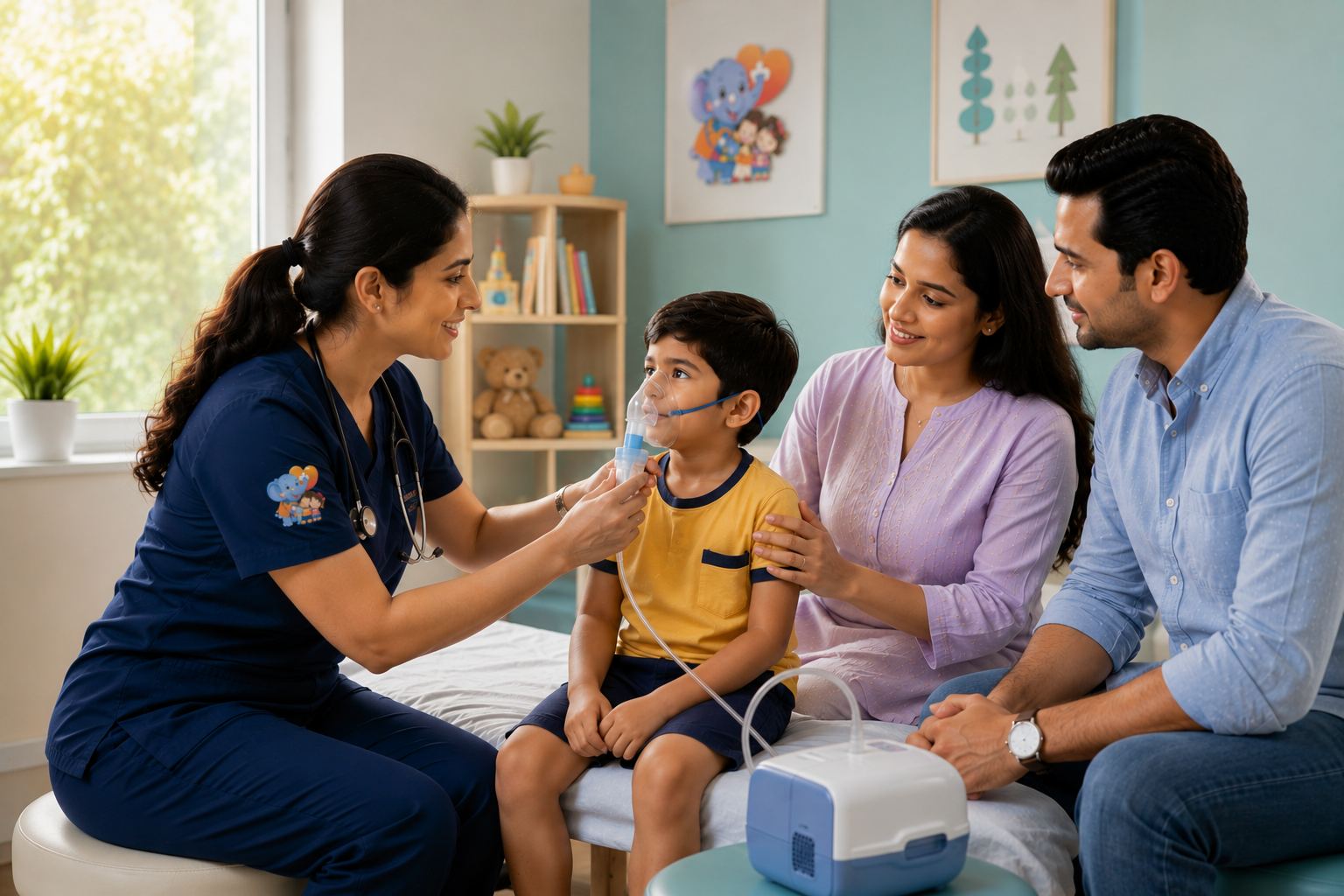
Nebulised or inhaled medication where indicated brings relief within minutes; we treat before we lecture.
Find the pattern
One episode is an infection; repeated episodes suggest asthma or allergy — we distinguish them and plan accordingly.
Equip the family
Inhaler-with-spacer technique taught hands-on, a written action plan, and clear thresholds for when to come back or go to emergency.

Evidence-based care
Every decision guided by the latest pediatric science
At home
Parent stories
“Our son was not saying a single word at 2.5. Within four months at Siraa he was putting two and three words together. The parent coaching made the biggest difference.”
Priya M.
DLF Phase 4
“We were told to wait and see. We did not, and I am so glad. The therapist identified exactly what was holding him back. Six months later he is chatting non-stop.”
Rahul K.
Sohna Road
“What sets Siraa apart is that they treat you as a partner, not just a parent dropping off a child. Every session I left feeling more capable and less worried.”
Sneha T.
Sector 56
Questions
Roughly: under 2 months, up to 60 breaths/minute; 2–12 months, up to 50; 1–5 years, up to 40; over 5 years, up to 30. Count for a full minute while the child is calm or asleep. Rates persistently above these, at rest, need medical assessment the same day.
Not necessarily. Many infants and toddlers wheeze only with viral colds and outgrow it. Asthma becomes likely when wheezing recurs without infection, appears with play or laughter, runs in the family, or accompanies eczema and allergies. A pediatrician distinguishes the patterns.
No — an inhaler with a spacer (and mask for young children) delivers medicine as effectively as a nebulizer for most situations, faster and with fewer side effects. Nebulizers have a role in severe episodes; neither is 'habit-forming'.
Yes. High AQI days measurably increase wheezing, coughing and asthma attacks in children. On very poor days: keep children indoors during peak hours, use purifiers where possible, ensure asthma preventer medicines are taken regularly, and never smoke indoors.
Siraa Health, Sector 67, Gurgaon, Haryana · Mon–Sat 9:00 AM – 7:00 PM · Sunday Closed
+91 93197 41273